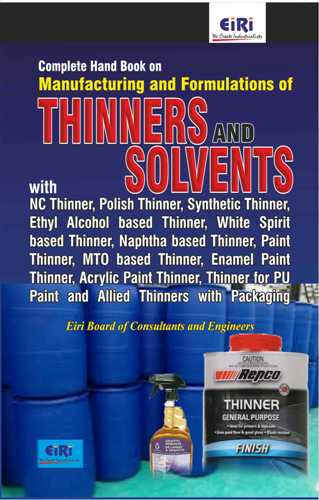
Complete Hand Book on Manufacturing and Formulations of Thinners and Solvents with NC Thinner, Polish Thinner, Synthetic Thinner, Ethyl Alcohol based Thinner, White Spirit based Thinner, Naphtha based Thinner, Paint Thinner, MTO based Thinner, Enamel Paint Thinner, Acrylic Paint Thinner, Thinner for PU Paint and Allied Thinners with Packaging
The book covers: Solvents used in degreasing, cleaning, thinners, paints, inks & adhesives, Solvents used in Paints, Paints Manufacturing, Paints and Solvents, Paint Thinner Ingredients, Paint Thinners Features, Uses & Application, Paint Thinners Manufacturing Method, Solvent and Thinners manufacturing with formulation, Manufacturing with Formula to Produce Thinners, White Spirit Based Thinner Manufacture With Formula, Naphtha Based Thinner Manufacture with Formula, Ethyl Alcohol Based Thinners Manufacturing with Formulae, Nitrocellulose Thinners (Nc Thinners) Production With Formula, Thinner Manufacturing, Various Raw Materials used For Thinner and Their Properties, Formulation and Process of Thinners (Stoving Enamel Thinner), Formulation of Polish Thinner, Formulation Of Synthetic Thinner (MTO Based), Formulation of Methanol Based Polish Thinner, Formulation Of Mto Based Thinner, Formulation of N C Thinners, Manufacturing Process of Thinners for - Nitro, Manufacturing Process for Nitrocellulose Thinners (With Formulations), Thinner Formulations for Brushing Lacquers, Formula of Enamel Paint Thinners, Formula of Thinner for Cellulose Acetate Base Lacquer Paints, Formulation of Thinner for Pu Paints, Formulation of Thinner for Epoxy Paints, Thinner Formulation for High Viscosity Wood Lacquer, Thinner Formulation of Automotive Primer, Thinner Formulation of Lacquer For Can Coating, Cellulose Acetate Butyrate Based Thinners for Spraying Lacquer Formulation, Thinner For Cellulose Acetate Based Coatings (Formula), General Process of Manufacture of Various Miscellaneous Thinners, Various Others Thinner Formulations, Packaging of Paint, Process and Waste Description, Thinner for Industrial Use with Thinner for Acrylic Paint, Thinner for Enamel Paint, Thinner for PU Paint, Thinner for Epoxy Paint, NC Thinner (Project Profile).
PREFACE
A paint thinner is a solvent used to thin oil-based paints or clean up after their use. Commercially, solvents labeled "Paint Thinner" are usually mineral spirits having a flash point at about 40 °C (104 °F), the same as some popular brands of charcoal starter. Common solvents used as paint thinners include: ● Mineral spirits (US) / White spirit (UK)
● Acetone
● Turpentine
● Naphtha
● Toluene
● Methyl ethyl ketone (MEK)
● Dimethylformamide (DMF)
● 2-Butoxyethanol, or any of the other glycol ethers
● Less common solvents used as paint thinner include:
● Ethylbenzene
● Xylene
● n-Butyl acetate
● Butanol
Exposure to vapours created by paint containing thinner or its clean up may be hazardous. The American Conference of Governmental Industrial Hygienists has established threshold limit values (TLVs) for most of these compounds. TLV is defined as the maximum concentration in air which can be breathed by a normal person (i.e., excluding children, pregnant women, etc.) in the course of 40 hours work (in US work conditions) per week, day after day through their work life without long-term ill effects. In underdeveloped countries workers commonly experience (vi) much higher exposure to these chemicals with consequent damage to their health. Lacquer thinners are certainly effective household items for the removal of sheen on surfaces. In order to understand the uses of a lacquer thinner, you need to know what lacquer is in the first place. It is often a slightly coloured substance at first, but it dries away clear by the evaporation of a solvent. A lacquer thinner is a simple solution that breaks or dissolve down the thick properties of varnishes and paints, lacquer, oils, grease, and other strong adhesive material. It is used to dissolve, dilute, and clean up basic lacquer items in the house.
Lacquer thinners are a little caustic for oil paints and may cause cracks in the sheen of the surface. It may deteriorate the surfaces and fabrics of items in the house. You need to make sure that you apply it in a small and rather inconspicuous area before you decide to apply it on a bigger countertop or surface.
The best uses for a lacquer thinner have been stated below with detail. You can easily find a lacquer thinner in the market and use it to remove the sheen or gloss on any surface in your house. Make sure you apply it slowly and carefully without dabbing the thinner on in big amounts. You can easily remove tar, tree sap, and grease from various surfaces in your house using lacquer thinner. Turpentine is a very helpful lacquer thinner for oil and alkyd-based paints plus varnishes. In addition to that, other products have showed up in the market and they perform the same tar-removing function with relatively less odorous and toxic vapours. Some lacquer thinners even has mineral spirits. Lacquer thinners are also used to dissolve shellac and aniline dyes in the house. It contains denatured alcohol that acts like a strong cleaning agent on the sheen and gloss of surfaces. Lacquer thinners can also be used for cleaning purposes. With a kerosene component in the lacquer thinner, you can use it as a strong solvent as well. Lacquer thinners typically do not contain such an element, but if mixed together, they make (vii) sure that unnecessary paint spots are removed easily from the surface you desire. It can remove hardened stains and paint on knobs of doors and other spots as well. Since lacquer thinners are usually made up of two solvents like amyl or ethyl, you can easily use them to thin down the sheen or gloss and use them to clean surfaces. Spray equipment is usually the way to use a lacquer thinner. They easily soften and thin away the paints that have turned solid and flaky on smooth surfaces. They also remove residue from cements and plastics. Varnish stains and paint spots can be removed on clothing of natural fibres by lacquer thinners as well. Remember to avoid using a nylon brush on solvents since the acetone in the thinner may weaken the bristles of the brush.
CONTENTS
1. Solvents used in degreasing, cleaning, thinners, paints, inks & adhesives
- Details
- Common Classes of Organic Solvents
- Effects
- Respiratory tract
- Skin
- Eyes
- Liver
- Kidneys
- Cardiovascular system
- Nervous system
- Organic solvent exposure and cancer
- Reproductive system
- Recommendations
- Elimination and Substitution
- Work Practices and Engineering Controls
- Personal Protective Equipment
- Emergencies and First Aid
2. Solvents used in Paints
- Purpose of solvent in a paint
- Latent solvent or secondary solvent or co solvent
- Non-solvent/Diluent
- Testing of solvents
- Physical tests
- Chemical tests
- (x) Boiling point or distillation range
- Aniline point and mixed aniline point
- Relative evaporation rate
- Copper strip corrosion
- KB value
- Types of solvents
- Hydrocarbon solvents
- Benzene, Toluene, Xylene (BTX)
- Solvent Naphtha
- Mineral spirit
- Kerosene
- Turpentine
- Halogenated hydrocarbons
- Montreal Protocol
- Oxygenated hydrocarbon
- Alcohols
- Esters
- Amides
- Ketones
3. Paints Manufacturing
- Technology Description
- Emission Sources
- Primary Emission Reduction Measures
- Economic Aspects
- Secondary Emission Reduction Measures
4. Paints and Solvents
- Solvent
- Types of Paint and Solvent
- Primers /Sealers
- Finish Paints
- Levels of Gloss
- Paint Is Composed of four Basic Types of Materials
- Uses of Paint and Solvent
- How Should Paint and Solvent BE Stored And Transported
- Storage and Transport
- Disposal Methods for Paint And Solvents
- Cleanup and Disposal
- Environmental Risks
- Issues List
5. Paint Thinner Ingredients
- Turpentine
- Mineral Spirits
- Methyl Ethyl Ketone (MEK)
- Acetone
6. Paint Thinners Features, Uses & Application
- Thinner Applications
- Specifications of NC Thinner are
- Specification
- Features
- PU Thinner
- Epoxy Thinner
- Features
- Acrylic Paint
- Features
- Uses
- Synthetic Paint Thinners
- Common solvents used as paint thinners include
- Features
- Synthetic Coach Enamel Thinners
- Technical bits you may want to know
- Paint Thinner
- Lacquer Thinner0
- Solvent
- Paint Thinner
7. Paint Thinners Manufacturing Method
- Requirements of the solvents
- Factors affecting the selection of solvents:
- Requirements of the thinners
- Functions of the thinners
- Solvents, safety and the environment.
- Making an Oil Thinner for Oil Paint
- Method 2
- Thinning Oil Paint with Common Solvents
- Method 3
- Using Water as a Thinner for Acrylic and Latex Paints
- Thinner formulation
- Manufacturing thinner
- NC Lacquer manufacture wit formula
- What is NC thinner?
- What is lacquer thinner?
- Is lacquer thinner the same as paint thinner?
- What is the correct mixture ratio paint to thinners and clear to thinners?
- Common solvents used as paint thinners include:
8. Solvent and Thinners manufacturing with formulation
- Aliphatic Hydrocarbons
- Romatic Hydrocarbon
- Naphthalene derivatives
- Formulations
- Followings Solvent to Produce Thinner For NC Lacquers
- Preparation
- Thinner Formulations for Brushing Lacquers
- Manufacturing Process In Paint & Varnish Industries
- Terpene solvents
- Petroleum Thinners of Ordinary Types
- High Solvency Naphthas
- What is the composition of thinner?
- Thinner
- Formula
9. Manufacturing with Formula to Produce Thinners
- Solvent
- Thinners and Solvents
- Aliphatic Hydrocarbons
- Aromatic Hydrocarbon
- Naphthalene Derivatives
- Process of Manufacturers & Formulations
- Thinner formulation
- A typical thinner formula proposed by them is
- PU thinner composition
- Low-Viscosity Nitrocellulose
- Hot Spray Application
- Other Formulations
10. White Spirit Based Thinner Manufacture With Formula
- What is the difference between solvent-based paint and water-based paint? What are the advantages of both of the types?
- Manufacturing Process
- Process of Manufacturers & Formulation
- Thinner Formulations for Brushing Lacquers
- Thinner Formulations
- (All parts by weight)
- Formulation of Commonly used Thinners
- High-Solids Lacquers
- Thinners for Stoving Paints
- Terpene Solvents
11. Naphtha Based Thinner Manufacture with Formula
- (A) Petroleum Naphtha
- (B) Thinner
- Hazard
- Properties & Characteristics
- Naphtha
- Hazard
- Formulation Formulation No : 1
- For Naphtha Based Thinner
- Formulation No. : 2 (Used In This Project)
- Process Of Manufacturing Of Naphtha Based
- Thinner From Crude Naphtha
- (A) Production of Pure Solvant Naphtha :-
- (B) Blending section for Naphthan Based
- Thinner Making
12. Ethyl Alcohol Based Thinners Manufacturing with Formulae
- Manufacturing Process
- Process
- For Preparing 200 Ltrs. Thinner
13. Nitrocellulose Thinners (Nc Thinners) Production With Formula
- Solvent
- Formulation
- Higher Grade
- Medium Grade
- Lower Grade
- Manufacturing Process
- Filteration
- Storage
- Packing
- Plant & Machinery
14. Thinner Manufacturing
- Diluents & Thinners
- Thinner
- Properties & Characteristics
- 1. Solvent Power
- 2. Volatility
- 3. Stability
- 4. Toxicity
- 5. Flash point and inflammability
- Petroleum Hydrocarbons
- Diluents
- Paint And Varnish Thinners
- Turpentine
- Wood Turpentine
15. Various Raw Materials used For Thinner and Their Properties
- Naphtha
- Substitutes Of Naphthais Benzol
- White Spirit (Mineral Spirit)
- Benzol (Solvent From Coaltar)
- Benzene
- Solvents For Storing Enamels Paints
16. Formulation and Process of Thinners (Stoving Enamel Thinner)
- Manufacturing Process for Stoving Thinner
17. Formulation of Polish Thinner
- Formulation of Polish Thinner
18. Formulation Of Synthetic Thinner (MTO Based)
19. Formulation of Methanol Based Polish Thinner
- Formulation of Polish Thinner (Denatured Spirit Based)
- General Composition Of Polish Thinner
20. Formulation Of Mto Based Thinner
- Formulation-1
- Formulation-2
21. Formulation of N C Thinners
- Thinners For Nitrocellulose Base Lacquers (ICI Type) N.C. Lacquer Thinner
- Formulation - 1
- Formulation - 2
- N. C. Laquer Thinner
- A High Solvency Mixture Can Be Made Up From.
- Formulation - 3
- N. C. Lacquer Thinner
- (Hot Spray Solvent Combination)
- Formulation - 4
- Acetone Used In Thinner Formulations In Paints Cooling Sensation.
- Formulation - 5
- Formulation - 6
- Formulation - 7
- Formulation - 8
22. Manufacturing Process of Thinners for - Nitro
- Cellulose Base Lacquers (Ici Type)
- High Grade
- Medium Grade
- Lower Grade
23. Manufacturing Process for Nitrocellulose Thinners (With Formulations)
- Filtration
- N. C. Thinners
- Quick Cutting N. C. Thinners
- High-low N- C Thinner
24. Thinner Formulations for Brushing Lacquers
- Process Of Manufacturers & Formulations
- Thinner Formulations For Brushing Lacquers
- Low-viscosity Nitrocellulose
- Acrylic Thinners For Clear Coating
25. Formula of Enamel Paint Thinners
26. Formula of Thinner for Cellulose Acetate Base Lacquer Paints
- Thinners for Cellulose Acetate Base Lacquers
27. Formulation of Thinner for Pu Paints
28. Formulation of Thinner for Epoxy Paints
29. Thinner Formulation for High Viscosity Wood Lacquer
30. Thinner Formulation of Automotive Primer
31. Thinner Formulation of Lacquer For Can Coating
32. Cellulose Acetate Butyrate Based Thinners for Spraying Lacquer Formulation Formulation
33. Thinner For Cellulose Acetate Based Coatings (Formula)
- Thinner Formulations (All Parts By Weight)
- Other Formulations
- Thinner For Paints
34. General Process of Manufacture of Various Miscellaneous Thinners
- For Instance, Plant & Machinery
35. Various Others Thinner Formulations
- A. D Thinner
- Antichill Thinner
- Cleaning Thinner
- Epoxy Thinner
- Etch Primer Thinner
- Flexo Thinner
- G P Thinner
- Multi Purpose Thinner
- NC Thinner I
- NC Thinner II
- NC Thinner III
- P U Thinner
- Retarder
- Screen Thinner
- Stoving Thinner I
- Stoving Thinner II
- Super quality Auto Thinner
- Thinner for chlorinated Rubber Paint
36. Packaging of Paint
- Single Reduced Tinplates
- Coating Weight
- Double Reduced Tinplate
- Plastic
- Fluorinated containers
- Permeation chemistry
- Different types of industrial paint packaging
- Test method for Packaging material:
- Flexible packing materials
- Tin plate containers
- HDPE blow moulded containers
- International Maritime Dangerous Goods (IMDG)
- Packaging & Recycling
- Comparison between screen & offset printing
37. Process and Waste Description
- Introduction
- Process and Waste Description
- Solvent-Based Paints
- Water-Based Paints
- Pollution Prevention Via Process Modifications
- Pollution Prevention Via Resource Recovery and Recycling
- Pollution Prevention Via Better Housekeeping and Operating Practices
38. Thinner for Industrial Use with Thinner for Acrylic Paint, Thinner for Enamel Paint, Thinner for PU Paint, Thinner for Epoxy Paint, NC Thinner (Project Profile)
- Formulation And Process of Thinners
- Manufacturing Process for Stoving Thinner
- Finish Coat
- Plant Economics of Thinners for Industrial Use
- Plant And Machinery
- Fixed Capital
- Raw Materials
- For Stoving Thinner
- For Nitrocellulose Lacquer Thinner
- For Acrylic Paint Thinner
- For Enamel Paint Thinner
- For General Lacquer Thinners
- For Pu Paint Thinner
- For Epoxy Paint Thinner
- Total Working Capital/Month
- Total Capital Investment
- Turn Over/Annum
LIST OF FIGURES
Fig. 2.1: Solubility Parameter
Fig. 2.2: Desirable order of departure of solvents from the film
Fig 2.3: Effect of non solvents and latent solvent on the solution viscosity
Fig. 37.1. Block flow diagram of the solvent-based paint process in plant B.
Fig. 37.2. Block flow diagram of the water-based paint process in plant B.
LIST OF TABLES
Table 2.1: Properties of some solvents
Table 2.2: Solubility Parameter for some polymers (1)
Table 2.3: Solubility Parameter of important
Table 2.4: Relative evaporation rates of solvents at 25°C(2)
Table 2.5: Composition of vegetable turpentine (3)