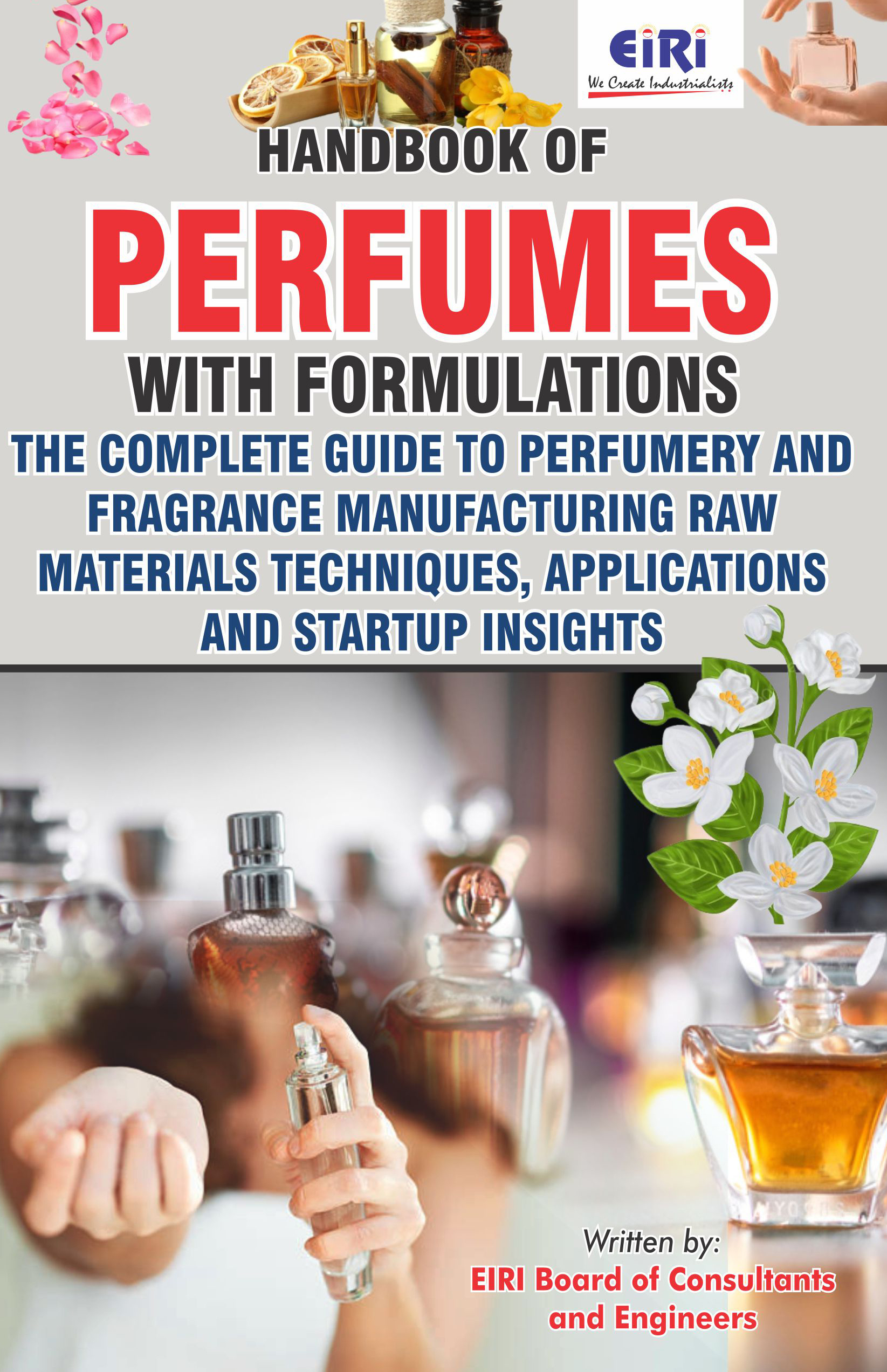
Handbook of Perfumes with Formulations (The Complete Guide to Perfumery & Fragrance Manufacturing - Raw Materials, Techniques, Applications & Startup Insights)
isbn-9788199282711
The book Hand Book of Perfumes with Formulations covers almost all the basic and advanced details of preparations of various types of Fragrances, Perfumes with their packaging methods. The chapters in this book are: PART 1: Fundamentals of Perfumery & Creativity: Creating Perfume (The artistic, scientific, and practical foundations of perfume creation, including tone, intensity, tenacity, and systematic formulation), Olfaction and Gustation: The Sense of Smell and Taste (Understanding sensory perception and its critical role in perfumery design}, Classification of Odours and Odourants (Systematic categorization of scents based on their physical and olfactory characteristics}, Trends in Niche & Indie Perfumery (The niche perfume market is booming due to consumer demand for unique, story-driven, and ethically conscious fragrances), PART 2: Raw Materials and Ingredients: Raw Materials of Perfumes (Natural Origin) (In-depth guide to essential oils, absolutes, tinctures, balsams, and natural perfumery compounds), Raw Materials of Perfumes (Synthetic Origin) (Comprehensive list of synthetic aroma chemicals, their properties, and uses), PART 3: Formulation Techniques & Types of Perfumes: Flower Perfumes and Their Formulation (Profiles and formulation tips for over 40+ floral-based perfumes), Sophisticated/Fantasy Perfumes and Their Formulation (Aldehydic, oriental, chypre, and other fantasy types explored), Colognes: Perfumes for Men (Gender-specific scent creation and alcoholic strength variations), Aromatic Perfumery Compounds (Fancy, royal, and floral bouquets with raw material suggestions), Perfumery Compounds (Extraction processes for natural perfume bases like rose concrete and absolutes), Perfumes for Soap, Detergent, Agarbatti, etc. (Industrial and mass-use perfume compounds for functional products), Intimate Scents, Chemicals, etc. from All Types of Flowers (Manufacturing intimate and specialty fragrances), PART 4: Manufacturing & Applications: Scents and Perfumes (Industrial scent extraction, machinery, and financials), Spray (Perfume) (Aerosol-based perfumes and their formulations), Aerosol Spray (Equipment, costing, and practical steps in spray production), Applications of Perfumes (Perfuming cosmetics, soaps, air fresheners, pharmaceuticals, etc.), PART 5: Testing, Analysis & Quality Control: Testing of Perfumes (Lab methods for testing density, freezing point, olfactory strength, solubility, refractive index, and more), PART 6: Packaging & Branding: Packaging of Perfumes ( Visual identity, bottle design, labeling, advertising, and fashion integration), PART 7: Industry Resources & Suppliers: Suppliers of Plants and Equipment, Suppliers of Packaging Materials, Suppliers of Raw Materials, Present Manufacturers/Suppliers/Exporters, Regulatory & Safety Compliance (IFRA, EU, FDA) and Plant Economics of Perfume Manufacturing Unit.
Chapter 1
Creating a Perfume (The artistic, scientific, and practical foundations of perfume creation,including tone, intensity, tenacity, and systematic formulation)
- Introduction
- Working within a Framework
- Price
- Packaging
- Inspiration
- The Practical Foundation
- Inspiration: Response to Stimuli
- Colours
- Jeancard on Composition
- Limitations of formulae
- The perfumer’s knowledge of chemistry
- Creativity in the Art of Perfumery
- Carles’ Method
- Merit of Carles’ System
- Fixation
- Systematic Recording of Data
Chapter 2
Olfaction and Gustation: The Sense of Smell & Taste (Understanding sensory perception and its critical role in perfumery design)
- Introduction
- Olfaction
- Mechanism of Perception
- Odourous and Odourless
- What Makes a Substance Smell?
- A Coding System for Olfactory Specificity
- How/Does a Perfumer ‘See’ Odours?
- Abnormalities of Smell
- Gustation
- The Complexity of Flavour Perception
- Tante-Sensitivity, Intuition and introversion
Chapter 3
Classification of Odours and Odourants (Systema tic categorization of scents based on their physical and olfactory characteristics)
- Introduction
- Classification based on physical characteristics
- Floral Series
- Woody Series
- Rustic Series
- Balsamic Series
- Fruity Series
- Animal Series
- Empyreumatic Series
- Edible Series
Chapter 4
Trends in Niche and Indie Perfumery
- Indie Perfumery
- Similarities and Differences with Niche Perfumes
- Boutique vs. Indie Fragrance
- Indie vs. Craft vs Artisan Fragrances
- Demand for unique and personalized fragrances
- Individuality and selfexpression
- Emphasis on storytelling
- Rise of ethically conscious and sustainable perfumery
- Perfume Market Growth Factors
- Indie/Niche Brands: The Artisans of Innovation
- Hyper-Personalization: Byredo’s Mojave Ghost and Gen Z Engagement.
- Clean & Transparent Scents: Fragrance without allergens, phthalates, parabens
- Common fragrance allergens
- Brands specializing in clean fragrances
- Phthalates and parabens
- Ethical Sourcing of Ingredients
- Sustainable Practices in Production
- Benefits of Sustainable and Ethical Fragrance
- Upcycled ingredients (e.g., Firmenich’s Clearwood)
- Firmenich’s Clearwood
- The importance of upcycled ingredients for sustainability
- Biodegradable packaging
- For Widespread & Accessible Solutions
- For Sustainable Sourcing Strategies
- Fair-trade essential oils
- What to Look for in Fair-Trade Essential Oils
- AI and Technology in Formulation
- AI-assisted note prediction
- Key aspects of AI-assisted note prediction include:
- Key Applications of AI in Perfumery
- How the Technology Works
- Example in Practice
- Leading AI tools in perfumery
- Givaudan’s Carto .
- IBM and Symrise’s Philyra
- Benefits in prototyping and
- time-saving
- Minimalism in Fragrance
- For a Simple, Personal Scent
- For an Abstract, Unique Statement
- For Sophisticated, Refined Scents
- Single Note Fragrances
- “My Skin But Better” Scent
- For a Unique and Comforting Warmth
- For a Fresh and Silky Finish
- Consumer Co-Creation
- Custom perfumes via online
- configurators
- How it Works
- Benefits
- Brands letting users choose base/middle/top notes
- How it Works
- Benefits of Co-Creation
- Natural vs. Synthetic: Key Differences
- Evolving Public Perceptions
- The Future of Perfumery
- How synthetics are safer in some cases
Chapter 5
Raw Materials of Perfumes(Natural Origin)
- Introduction
- Essential oils
- Absolute oils
- Natural Odourants Employed in Perfumery
- Concrete Oils
- Absolute Oils
- Essential Oils derived from Distillation
- Essential Oils Obtained by Expression
- Isolates from Essential Oils
- Natural Odourants as Tinctures
- Balsams and Resins
- Concrete oils or ‘Concretes’
- Absolute oils
- Floral Series
- Rose notes
- Bulgarian rose absolute
- Moroccan and Turkish rose absolutes
- Absolute of rose geranium
- Absolute Oil of Rose Leaves
- Jasmine notes
- Lilac and Lily
- Orange-blossom notes
- Tuberose notes
- Violet notes
- Mignonette notes
- Woody Series
- Sandal notes
- Peppery notes
- Caryophyllaceous notes
- Rural Series
- Herbaceous notes
- Fruity Series
- Animal Series
- Amber notes
- Maritime notes
- Musk notes
- Costus absolute
- Empyreumatic Series
- Tobacco notes
- Expressed Essential Oils
- Bergamot
- Grapefruit
- Lemon .
- Mandarin .
- Orange .
- Orange, Sweet (Portugal)
- Isolates, Esters etc.
- Anise Oil
- Bois de rose oil (Brazil)
- Camomile oil (German)
- Cedarwood oil (Virginian)
Chapter 6
Raw Materials of Perfumes (Synthetic Origin)
- Introduction
- Types of Synthetic Fragrances
- Full Synthetic Fragrances
- Semi-Synthetic Fragrances
- Nature-Identical Compounds
- Completely Artificial Scents
- The Creation Process
- Phenylacetaldehyde .
- Hydratropic aldehyde
- Nonadienal diethyl acetal
- Dihydro-nor-dicyclopentadienyl acetate
- Bitter Almond
- Aniseed
- Melon notes
- Angelica oils
- Woody Notes
- Empyreumatic Notes
- Animal Notes
- Principal odourants of animal origin
- Musks, Synthetic
- Civet, Synthetic
- Ambergris, Synthetic
- Chaulmoogra oil
- Castoreum Synthetic
- Hexyl benzoate (woody-greenbalsamic)
- Citronellyl ethoxylate (sweet, musky, ambrette odour)
- The Salicylates
- IsoAmyl salicylate
- Benzyl salicylate
- Isobutyl salicylate
- Methyl salicylate
- Ethyl salicylate
- Santalyl acetate
- Styrallyl acetate (methyl phenyl carbinyl acetate)
- Terpinyl acetate
- Trichloromethyl phenyl carbinyl acetate
- Vetiveryl acetate
- The Fatty Alcohols, Aldehydes and Acetals
- Acetophenone
- Amyl cinnamic aldehyde .
- Anisic alcohol
- Anisic aldehyde .
- Ethyl vanillin (Vanillal, Bourbonal)
- Eugenol
- Fixateur 404 (Firmenich)
- Geraniol
- Heliotropin
- Heptanal glyceryl acetal
- isoHexenyl tetrahydro benzaldehyde
- Hexylcinnamic aldehyde
- Hydroxycitronellal
- Indole
- lonone alpha
- lonone beta
- isoJasmone
- Linalool
- Menthone
- Vanillin
Chapter 7
Flower Perfumes and their Formulations (Profiles and formulation tips for over 40+ floral-based perfumes)
- Introduction
- Formula 1: Rose
- Formula 2: Odourants
- Formula 3: Rose F
- Formula 4 (Rose H)
- Formula 5 (Rose rouge)
- Formula 6 (Rose blanche)
- Formula 7: Jasmine 1
- Formula 8: Jasmine 2
- Formula 9: Jasmine 22.0, Fantasy 3
- Formula 10: Jasmine Base 5
- Formula 11: Jasmine base 5a
- Orangeflower and Neroli
- Formula 12: Orange flower A
- Formula 13: Neroli A
- Formula 14 (Violet 1)
- Formula 15 (Violet 2)
- Formula 16 (Parma Violets Absolute Art)
- Formula 17 (Violet base)
Chapter 8
Sophisticated/Fantasy Perfumes and their Formulations (Aldehydic, oriental, chypre,and other fantasy types explored)
- Formula 1
- Formula 2 (Curacao Base)
- Formula 3 (Perfume Cuir base 1)
- Formula 4 (Perfume woody base 1)
- Formula 5 (Perfume QH I)
- Formula 6 (Bouvardia BM)
- Formula 7 (Parfum AO)
- Formula 8 (Parfum F)
- Formula 9 (Perfume HB)
- Aldehydic Perfumes
- Formula 10 (Perfume VN)
- Manufacturing Processes
- Ingredient Sourcing
- Blending & Concentration
- Aging/Maturation
- Dilution
- Filtration
- Bottling
- Packaging
- Alcoholic Strengths
- Control
- The diagram shows how oil is expected in use of production of perfume
Chapter 9
Colognes: Perfumes for Men (Gender-specific scent creation and alcoholic strength variations)
- Introduction
- For Personal Expression & Well-being
- For Practical & Everyday Uses
- Toilet waters
- Modified Colognes
- Perfumes for Men
- Perfume Production Line
Chapter 10
Aromatic Perfumery Compounds (Fancy, royal, and floral bouquets with raw material suggestions
- Types of Aromatic Compounds
- Sources and Uses
- Role in Perfumery
- Manufacturing Process
- Fancy Bouquet Formulation:
- Royale Bouquet Formulation
Chapter 11
Perfumery Compounds (Extraction processes for natural perfume bases like rose concrete and absolutes)
- Rose Concrete
- Rose Absolute
- Sources of Perfumery Compounds
- Natural Sources
- Synthetic Sources
- Examples of Perfumery Compounds
- Purpose in Perfumery
- Process of manufacturing
- Aging and Maturation
- Filtration and Quality Control
- Bottling and Packaging
Chapter 12
Perfumes for Soap, Detergent and Agarbatti etc. (Industrial and mass-use perfume compounds for functional products)
- Perfumes for soap
- Process of Manufacture
- Squeeze sprays (packs)
- Formula
- Procedure
- TYpes of fragrance liked in detergents
- Process of making agarbatti
Chapter 13
Intimate Scent, Chemicals etc. from all Types of Flowers (Manufacturing intimate and specialty fragrances)
- Key Chemical Components
- Manufacturing Process
Chapter 14
Scents and Perfumes (Industrial scent extraction, machinery, and financials)
- Scent Extraction Methods
- Industrial Machinery
- Key Factors for a Successful Business
- Process of Manufacture
- Extraction Process
- Extraction Volatile Solvent
- Artificial Intelligence Powered Fragrance Creation
- Essential Oil Extraction Machine
Chapter 15
Spray (Perfume) (Aerosolbased perfumes and their formulations)
- How a perfume spray works
- Formulation and Process
- Classification and Categorization of Aerosols
- Classification of Aerosols Based on Their Formulation
- Categorizing Aerosols Based on Their Formulation
- Types of Aerosol Packaging Containers
- Manufacturing aerosols is a complex process that involves several key steps:
- Manufacturing Process
- Essence and Perfumery
Chapter 16
Aerosol Spray (Equipment, costing, and practical steps in spray production)
- Equipment
- Cost Considerations
- Practical Steps in Production
- Preparation of the Product Concentrate
- Filling and Valve Assembly
- Propellant Filling
- Final Assembly and Quality Control
- Main components of the aerosol manufacturing process
- Propellants
- Product Concentrate
- Active ingredients
- Solvents
- Stabilizers
- Aromatic agents
- Aerosol containers
- Valve and actuator
- Propellants and the different types used in the aerosol manufacturing process
- Compressed Gases
- Aerosol manufacturing process
Chapter 17
Applications of Perfumes (Perfuming cosmetics, soaps, air fresheners, pharmaceuticals, etc.)
- Introduction
- In Cosmetics
- Applications of Perfumes in Soaps
- Factors Influencing Soap Perfuming
- Camouflage Odors
- Pharmaceuticals
- For personal use
- For environmental use:
- Industrial uses:
- Industrial Products
- Agricultural Products
- Animal baits and attractants
- Aldehydes and acetals
- Soap perfumery fashions
- Perfuming Synthetic Detergents
- Stability of Perfumery Chemicals
- Perfumed Disinfectants
- Perfuming the Air
- Incense and fumigants
- Formulation (A) of Herbal Incense Stick
- Paints and Polishes
- General Formulation Process
- Key Components
- Other Household Products
- Perfuming Cosmetics
- Perfuming Powders
- Perfuming Lipstick and Nail Lacquer
- Hair Preparation Perfumes
- Perfumed Aerosols
- Pharmacy and Medicine
- Industrial Perfumes
- Perfumes for Textiles
- Perfumed Ink and Paper
Chapter 18
Testing of Perfumes (Lab methods for testing density, freezing point, olfactory strength, solubility, refractive index, and more)
- Introduction
- Sensory Testing
- Instrumental Analysis
- Physical Properties
- Fragrance & Flavours Testing Process
- Methods for Testing Perfume Density
- Oscillating U-Tube Density Meter
- Flavor/Fragrance Density Meter
- Pycnometer (Volume-based Method)
- Preparation of the Material for Physico-chemical Analysis
- Physical Analysis
- Estimation of relative density
- Determination of refractive index by refractometer
- assessment of natural and synthetic perfumery materials
- Material Requirements
- Ethyl alcohol. Perfumery grade and Diethyl phthalate. Perfumery grade .
- Determination of ester value after acetylation and free alcohols
- Determine the ester value of the acetylated material a Determination of carbonyl value and content of carbonyl
- Standard iron solution
- Detection of petroleum and mineral oils
- Estimation of chlorine
- Determination of cineole content
Chapter 19
Packaging of Perfumes (Visual identity, bottle design, labelling, advertising, and fashion integration)
- Introduction
- The Impact of Aerosols
- Packaging of Perfumes
- Trends in Perfume Packaging Design
- The Means of Advertising
- Press Publicity
- Functions as an advertisement:
- Perfume packaging branding
- Perfume bottle design
Chapter 20
Suppliers of Plant and Equipments
- Perfume Filling Machine
- Refrigeration Plants
- Aerosol Filling Machine
- Storage Tanks
- Laboratory Equipment
Chapter 21
Suppliers of Packaging Materials
Chapter 22
Suppliers of Raw Materials
Chapter 23
Present Manufacturers/ Suppliers/Exporters (Business contacts, sourcing, packaging, and raw material vendors)
Chapter 24
Regulatory and Safety Compliance (IFRA, EU, FDA)
- International Fragrance Association (IFRA)
- Cosmetic Product Safety Report (CPSR)
- Ingredient Labeling
- Allergen Declarations
- U.S. FDA Regulations
- Key FDA Regulations for Perfumery Products
- Labeling Requirements under the Fair Packaging and Labeling Act (FPLA)
- Safety and Manufacturing Standards
- Safety Data Sheets (SDS) & IFRA Certificates
- Requesting from Suppliers
Chapter 25
Plant Economics of Perfume Manufacturing Unit