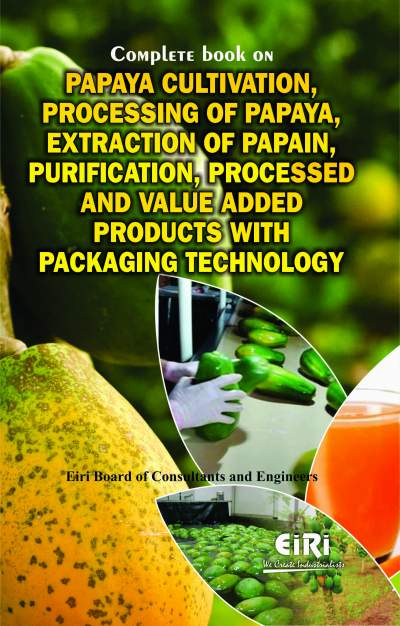
Complete book on papaya cultivation, processing of papaya, extraction of papain, purification, processed and value added products with packaging technology
The book contains the chapters: Papaya: The growing industry in India, Processing of Papaya, Processed And Value Added Products of Papaya, Cultivation of papaya, Organic Papaya Cultivation, Dried Papayas, Papaya Marmalades, Canned Papayas, Papaya Pulp, Extraction of Papain from Papaya Leaves, Manufacturing of Papain Extraction Process from Papaya Latex, Papaya - Raw Material for Food and Pharmaceutical Processing Industry, Sweet Manufacturing from Dried Fruit Papaya, Extraction of Papain From Papaya, Quality of Papaya, Growing of red lady Papaya, Harvesting and yields of papaya, Detailed Manufacturing Process of Papain, Papain Extraction (Money Minting Papaya), Foam-Mat drying of Papaya Pulp, Papain production from Papaya with process flow chart, Nutritional and pharmacological characterization of Papaya, Papaya cherry Making Unit, Papaya CROP (Description, Varieties, Uses, Cultural Practices and Production), Papaya processing machinery, Papaya Origin, Availability, Ripeness, Taste, Nutritional Value, Health Benefits, Storage, Recipe Etc., Papaya Producing States in India, Processing and Packaging of Papaya, Purification of Papain from Fresh Latex of Carica papaya, Tutti Frutti Manufacturing, Manufacturing of Papaya wine, Shelf Life of Packaged Food, Importance of Eco-friendly Packaging and its Sustainability, Packaging Laws and Regulations, Project Profile on Papaya Cultivation, Project Profile On Papain Extraction Industry, Project Profile on Papain From Papaya, Project Profile on Papain Enzyme Manufacturing Plant (Refined Papain), Project Profile On Papaya Growing And Papain Production, Project Profile on Tuti Fruity From Papaya Fruit, Project Profile On Pectin From Raw Papaya, Project Profile On Papaya Juice/Pulp, Project Profile on Papaya Candy
Papaya fruits are smooth skinned. They vary widely in size and shape, depending on variety and type of plant. Hermaphrodite plants of commercial 'Solo' varieties in Hawaii usually produce fruits that are pear shaped and weigh approximately to oz ( to g). Female plants of 'Solo' varieties produce round fruits. Other papaya varieties produce variously shaped fruits, which may weigh up to lb (. kg). The fruits usually contain many seeds surrounded by a smooth yellow to orange-red flesh that is sweet in good varieties.
Ripe papaya is usually consumed fresh as a breakfast or dessert fruit; it can also be processed and used in a variety of products such as jams, fruit juices, and ice cream. Papaya is also consumed as a dried fruit. Culled fruits can be fed to pigs and cattle.
Papaya is an ingredient in a variety of cuisines throughout the world. Unripe fruits and leaves are consumed as vegetables. Papaya seeds are also used as an ingredient in salad dressings.
Papain is a milky latex collected by making incisions in unripe papayas. The latex is either sun-dried or oven-dried and sold in powdered form to be used in beer clarifiers, meat tenderizers, digestion aids, wound debridement aids, tooth-cleaning powders, and other products. The 'solo' papaya is not a good variety for papain production due to its low yield of papain.
The papaya fruit is about .% water, . % carbohydrate, .% fiber, .% protein, .% ash and .% fat. A g (. oz.) serving of papaya has calories, compared to banana's calories. Papayas also contain % more vitamin C than oranges and are a good source of vitamin A (about half of that contained in mango). Consumption of the fruit is reported to aid digestion because of the papain content.
There are several uses of papaya from ripe papaya until the seeds. For the ripe papaya, it is commonly eaten fresh and the flesh is often cubed or shaped into balls and served as a fruit salad or fruit cup. Besides that, firm ripe papaya may be seasoned and baked for consumption as a vegetable while firm ripe papaya. In Malaysia, half ripe papaya was sliced and crystallized as a sweetmeat or it called halwa betik.
The papaya is a large pear-shaped fruit with golden-yellow skin. It can be to mm in length and can weigh as much as kgs. The pulp of the papaya is also golden-yellow and is fleshy, juicy and smooth. It has a sweet-tart flavor. It has a large central cavity which is filled with shiny, gray seeds. The papaya is a popular breakfast fruit in many countries and is also used in many food preparations like salads, pies, juices, and confections. Papaya pulp tissue disks in an incubation medium composed of . M sucrose evolve ethylene at an optimum pH of . at C.
Furthermore, this fruits also can produce a juice or nectar. As usual it can be sold as a fresh drink in bottles or can.
We at EIRI, New Delhi have just written this most important publications on Papaya. The book must be useful for new entrants who wish to enter into this trade. Project Profiles on papaya cultivation and processing and other papaya based units are being provided in this book.
AUTHOR
Contents
Papaya: The growing industry in India
Processing of Papaya
- Papaya Puree
- Canned Papaya Products
- Candied Papaya
- Jam And Jelly
- Juice, Concentrate and Nectar
- Dried Papaya Products
- Minimally Processed Products
- By-products From Papaya
- Papain
- Pectin
- Future Research Needs
Processed And Value Added Products of Papaya
- Introduction
- Uses of Papain
- Uses of Fruits
- Animal Feed
- Papaya leaf tea
- Paper Industry
- Papaya Exudates
- Papain
- Extraction of Papain
- Papain yield
- Papaya Candy
- Ingredients
- Method
- Process flow chart
- Papaya Jam
- Ingredients
- Papaya Leather–Ingredients
- Process flow chart
- Papaya Pickle–Ingredients
- Process flow chart
Cultivation of papaya
- Various Varieties of Papaya
- Climatic Condition for Papaya Farming
- Suitable Soil for Papaya Farming
- Propagation in Papaya Farming
- Preparing Land for Papaya Farming
- Planting in Papaya Farming
- Manuring and Fertilizers in Papaya Farming
Organic Papaya Cultivation
- Introduction
- Botany
- Varieties and countries of origin
- Uses and contents
- Aspects of plant cultivation
- Site requirements
- Seeds and seedlings
- Diversification strategies
- Biological methods of plant protection
- Diseases
- Pests
- Crop cultivation and maintenance
- Harvesting and post-harvest treatment
- Harvesting
- Post-harvest handling
- Product specifications
- Fresh papayas
- Processing
Dried Papayas
- Processing
- Sorting
- Washing and peeling
- Pulping and drying the fruits
- Sorting and packaging
- Labelling and storage
- Quality requirements
- Packaging and storage
- Packaging types and material
- Details given on packaging
- Transport packaging
- Information printed on transport packaging
- Storage
Papaya Marmalades
- Processing
- Sorting
- Washing
- Peeling and sorting
- Pulping and adding sugar
- Heating and boiling
- Adding citric acid, pectin and spices (optional)
- Filling into jars, vacuum-sealing and Pasteurising
- Cooling, labelling and storage
- Quality requirements
- Packaging and storage
- Packaging types and material
- Details given on packaging
- Transport packaging
- Information printed on transport packaging
- Storage
Canned Papayas
- Processing
- Sorting
- Washing
- Peeling and sorting
- Pulping
- Vacuum sealing, pasteurising or sterilising
- Cooling
- Labelling and storage
- Quality requirements
- Packaging and storage
- Packaging type and material
- Details given on packaging
- Transport packaging
- Storage
Papaya Pulp
Processing
Manufacturing papaya pulp
Quality requirements
Packaging and storage
Packaging type and material
Details given on packaging
Transport packaging
Information printed on transport packaging
Storage
Extraction of Papain From Papaya Leaves
Introduction
Enzyme
Origin
Morphology
Papain
Stability
Application
Measurement of activity
Antimicrobial activity of papain
Problem statement
Rationale and significance
Papain from papaya latex
Papain from papaya leaf
Commercialization of papain
Production of papain
Papain as an intracellular product
Extraction of raw material
Ultrasonication
Mechanism of ultrasonication
Condition for ultrasonication extraction
Enzyme assisted extraction
Mechanism of enzyme action
Type of enzyme used
Manufacturing of Papain Extraction Process
from Papaya Latex
Introduction
Materials and Methods
Material
Extraction of Latex
Extraction from Papain
Physicochemical and microbiological ana-lyzes
Enzymatic activity
Tyrosine method
Milk coagulation method
Implementation of papain in beer
Experimental design
Papaya - Raw Material for Food and
Pharmaceutical Processing Industry
Introduction
Nutritional value
Medicinal and Pharmacological properties of Papaya
Anti-malarial property
Antimicrobial property
Anthelmintic property
Papaya Enzymes
Pectin
Papaya and industry usage
Sweet Manufacturing from Dried Fruit Papaya
Results and Discussion
Extraction of Papain From Papaya
Quality of Papaya
Potassium Nutrition of Papaya
General effects on growth
Fruit growth and quality
Latex yield and quality
Growing of red lady Papaya
Harvesting and yields of papaya
Harvesting
Post-harvest handling
Yields
Detailed Manufacturing Process of Papain
Enzyme
Enzyme Classification
Papain
Properties of Papain
Manufacturing methods
Manufacturing process
Applications
World trade in papain
Corrigendum
Papain concentrate
Enzyme activity
Papain Extraction (Money Minting Papaya)
Production of Papaya for Papain
Foam-Mat drying of Papaya Pulp
Introduction
Materials and methods
Selection of fruits and foaming agents
Foaming experiments
Foam developing unit
Drying experiments
Quality analysis
Papain production from Papaya with process
flow chart
Origin of Papaya
Papain
Uses of Papain
Production of Papain
Process of Papain Production
Techno-Economics
Nutritional and pharmacological characterization
of Papaya
Introduction
Physiological disorders
Papaya skin freckles
Papaya pulp flesh translucency
Pulp softening in papayas
Hard lumps in papaya pulp
Papaya cherry Making Unit
Introduction
Product
Manufacturing Process
Raw Materials
Papaya CROP (Description, Varieties, Uses,
Cultural Practices and Production)
Fertilization
Papaya processing machinery
Washing, sorting and deseeding
Sterilization and filling
Plate sterilizer with aroma recovery
PAPAYA ORIGIN, AVAILABILITY, RIPENESS,
TASTE, NUTRITIONAL VALUE, HEALTH
BENEFITS, STORAGE, RECIPE ETC
Origin of Papaya
Availability of Papaya in India
Where to find Papaya in India
Checking for Ripeness in Papaya
Taste of Papaya
Nutritional Value of Papaya
Health Benefits of Papaya
Many scientific studies affirm these benefits:
How to Open/Cut
Papaya Recipe Ideas and Uses:
Flavor Complements
Random Facts
Binomial Name
Other Names
Papaya Producing States in India
Processing and Packaging of Papaya
Harvesting
Post harvest and Packaging
Physiological Post harvest Changes
Post harvest Treatment
Packaging
Processed Products
Purification of Papain from Fresh Latex
of Carica papaya
Tutti Frutti Manufacturing
Tutti Frutti Manufacturing Process
Tutti Frutti Manufacturing Quality Specification
Machinery Required For Tutti Frutti Manufacturing
Project
Manufacturing of Papaya wine
Introduction
Materials and Methods
Must Preparation
Physico-Chemical Analysis of Papaya Pulp
Yeast Culture
Inoculum Preparation
Fermentation
Physico-Chemical and Sensory Analysis of Papaya
Wine
Chemical Composition of Papaya Fruits
SUMMARY AND CONCLUSION
Shelf Life of Packaged Food
Quality of Food
The Alteration of Shelf Life
Bulk Density
The Transfer of Mass and Heat through the Package
Shelf Life Testing of Food Products
Literature Study
Turnover Time
End Point Study
Accelerated Shelf Life Testing
ASLT and Dehydrated Products
Dehydrated Products
Canned Foods
Starches
Time-temperature Records of Foods
Importance of Eco-friendly Packaging
and its Sustainability
Traditional Food Packaging Technologies
The Need for Packaging
Minimum Packaging Technology for Processed Foods
Food Unit Operations
Types of Packaging
Upgrading of Food Packaging
The Image of Packages
The Influence of Packaging on the Environment
Environmental Concerns that Impact Material Choices
Reducing the Environmental Impact of Packaging
Materials
Review and Change of Food Packaging Materials
Going Green on Fast Food Packaging
Eco-friendly Consumer Choices
Sustainable Packaging to Protect the Environment
Packaging Laws and Regulations
Unit Sale Price
General Guidelines on giving Declarations
Prevention of Food Adulteration (PFA)
Nutritional Food
Infant Food
Other Labeling Rules under PFA
Fruit Products Order (FPO)
Meat Food Products Order (MFPO)
Agmark Rules
Project Profile on Papaya Cultivation
Climate and Soil
Propagation
Planting and Season
Interculturing
Special Horticultural practices
Irrigation
Application of manures and fertilisers
Plant protection
Harvesting packing, post -harvest handling
Some additional features:
Project Profile On Papain Extraction Industry
Plant Economics Of Papain Extraction Industry
Plant & Machinery
Fixed Capital
Raw Materials
Total Working Capital/Month
Total Capital Investment
Turn Over/Annum
Project Profile on Papain From Papaya
What is Papain
Benefits of Papain
Papain Papaya
Plant Economics of Papain From Papaya
Plant & Machinery
Fixed Capital
Raw Materials
Project Profile on Papain Enzyme Manufacturing
Plant (Refined Papain)
Origin of Papaya
Papain
Plant Economics of Papain Enzyme Manufacturing
Plant
Plant & Machinery
Fixed Capital
Raw Materials
Total Working Capital/Month
Total Capital Investment
Project Profile On Papaya Growing And Papain
Production
Plant Economics of Papaya Growing and
Papain Production
Plant & Machinery
Fixed Capital
Project Profile on Tuti Fruity From Papaya Fruit
Introduction
Tutti Frutti Manufacturing Process:
Tutti Frutti Manufacturing Quality Specification:
Machinery Required For Tutti Frutti Manufacturing
Project:
Plant Economics of Tuti Fruity From Papaya Fruit
Plant & Machinery
Project Profile On Pectin From Raw Papaya
Papain and Pectin From Papaya
Process of Manufacturing
Raw Material, Consumable and Spares Etc
Plant Economics of Pectin From Raw Papaya
Plant & Machinery
Project Profile On Papaya Juice/Pulp
Plant Economics of Papaya Juice/Pulp
Total Working Capital/Month
Total Capital Investment
Turn Over/Annum
Project Profile on Papaya Candy
Plant Economics of Papaya Candy
Plant & Machinery
List of Tables
Table : Experimental design.
Table : Physicochemical and microbiological properties of the extracted papain.
Table . Beer turbidity results.
Table : constituents of different parts of the papaya
tree
Table : Proximate analysis of ripe and unripe
papaya fruits
Table : Nutritional value of fresh papaya
Table : medical function in papaya plant
Table .: Effect of potassium application on the latex
yield and its quality in papaya.
Table Chemical Composition of Papaya Juice
Table Chemical Composition of Wine from Papaya
Table : Traditional Food Processing using Enzymes
List of figures
Figure Flow sheet of integrated process for the production of papain and pectin
Irrigation In Papaya Farming.
Harvested Papaya
Figure . Effect of ultrasonication time on the extraction yield of Epimedin C from fresh Epimedium leaves
Figure . Control, non-sonicated, shows a high density of excretion hairs
Figure . Pot marigold petal sonicated at kHz. All excretion hairs were destroyed by ultrasound
Figure . Pot marigold petal sonicated at kHz. Only top of excretion hairs are destroyed
Figure Papain extraction process.
Figure Papain yield in the different treatments. Means with the same letter are not significan-tly different
(P < .).
Figure . Papain enzymatic activity. A. Tyrosine produc-tion method, B. Coagulation method. Means with the same letter are not significantly diffe-rent (P < .).
Fig. . Effect of K application on fruit weight and fruit yield per plant in papaya (average for four locations)
Fig. . Potassium effect on size of fruit
and yield of papaya
Fig. Photos showing standard symptoms of skin freckles. A - Photo shows the fruit surface that was directly exposed to the sun, exhibiting an increased presence of blemishes. B - Photo shows the other side of the same fruit, which was not exposed to the sun, featuring reduced blemish incidence.
Fig. Standard symptoms for skin freckles in papayas cv. The number of points is an estimation of the fruit area sampled stricken with the blemish. Each point has an area of . mm
Fig. . A and B - Photos showing the bagging of papaya fruit in an orchard in São Francisco de Itabapoana, RJ. The fruit, without any sign of skin freckles, were bagged approximately days before their harvest date.
Fig. . Top photo shows a cv. Golden papaya fruit with symptoms of pulp flesh translucency (B) compared with a healthy fruit (A). Lower photo shows the outer appearance of the fruit with no symptoms that distinguish it from healthy fruit (C) and from those with flesh translucency (D).
Fig. . Photo showing a cv. Golden papaya fruit with pulp flesh translucency symptoms. It is possible to observe that the skin of the fruit detaches easily from the pulp, a condition not typically found in healthy fruits.
Fig. . Samples of healthy (A, C, and E) and flesh translucency (B, D, and F) papaya fruit mesocarp. Scanning electron micrographs (A and B) show plasmolized cells and intercellular spaces in pulp flesh translucency (arrows), Bars = mm. Light microscopy (C and D) shows the intercellular space in pulp flesh translucency (arrow), Bars = mm. Transmission electron microscopy from cell wall (E and F) showing disestablished cell wall in pulp flesh translucency, bars = . mm.
Fig. Photos showing healthy papaya (C. papaya L.) fruit (A), and with symptoms of hard lumps in the pulp (B and C, arrows). Photos B and C were kindly provided by Dr. M. Suzuki, Caliman Agrícola S/A, Linhares, ES.
Fig. Schematic diagram shows the role of the heat shock proteins (HSPs) in ripening papaya fruit. (A) Papaya fruit development with gradually increase of temperature and thermotolerance acquisition: ripening fruit normally with softness pulp. (B) Papaya fruit development with fast increase of temperature and no time for thermotolerance acquisition:
Fig. The steps involved in the preparation of papaya wine is given in following figure