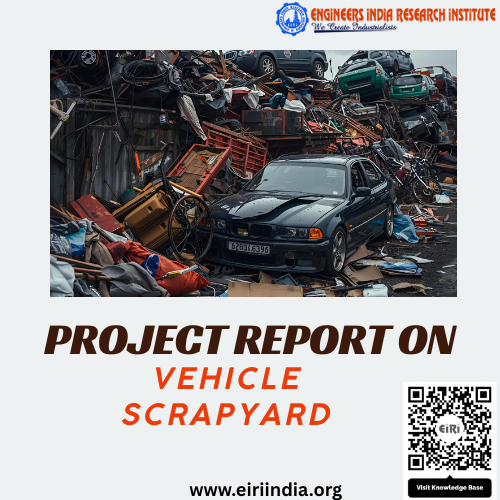
VEHICLE SCRAP YARD FOR PASSENGERS VEHICLES
[EIRI/EDPR/4810] J.C.: 3032XL
Vehicle recycling is the dismantling of vehicles for spare parts. At the end of their useful life, vehicles have value as a source of spare parts and this has created a vehicle dismantling industry. The industry has various names for its business outlets including wrecking yard, auto dismantling yard, car spare parts supplier, and recently, auto or vehicle recycling. Vehicle recycling has always occurred to some degree but in recent years manufacturers have become involved in the process. A car crusher is often used to reduce the size of the scrapped vehicle for transportation to a steel mill.
The process of recycling a vehicle is extremely complicated as there are many parts to be recycled and many hazardous materials to remove. Briefly, the process begins with incoming vehicles being inventoried for parts. The wheels and tires, battery and catalytic converter are removed. Fluids, such as engine coolant, oil, transmission fluid, air conditioning refrigerant, and gasoline, are drained and removed. Certain high value parts such as electronic modules, alternators, starter motors, infotainment systems - even complete engines or transmissions - may be removed if they are still serviceable and can be profitably sold on; either in "as-is" used condition or to a remanufacturer for restoration. This process of removing higher value parts from the lower value vehicle body shell has traditionally been done by hand. As the process is labour intensive, it is often uneconomical to remove many of the parts.
A technique that is on the rise is the mechanical removal of these higher value parts via machine based vehicle recycling systems (VRS). An excavator or materials handler equipped with a special attachment allows these materials to be removed quickly and efficiently. Increasing the amount of material that is recycled and increasing the value the vehicle dismantler receives from an end-of-life vehicle (ELV).
After all of the parts and products inside are removed, the remaining shell of the vehicle is sometimes subject to further processing, which includes removal of the air conditioner evaporator and heater core, and wiring harnesses. The remaining shell is then crushed flat, or cubed, to facilitate economical transportation in bulk to an industrial shredder or hammer mill, where the vehicles are further reduced to fist-sized chunks of metal. Glass, plastic and rubber are removed from the mix, and the metal is sold by multiple tons to steel mills for recycling.
COST ESTIMATION
- Plant Capacity 4 Nos/Day
- Land & Building (4000 sq.mt.) Rs. 2.28 Cr
- Plant & Machinery Rs. 44.00 Lacs
- Working Capital for 1 Month Rs. 53.50 Lacs
- Total Capital Investment Rs. 3.35 Cr
- Rate of Return 42%
- Break Even Point 48%
CONTENTS
- INTRODUCTION
- VEHICLE SCRAPPAGE POLICY
- SOME INCENTIVES FOR SCRAPPING OLD VEHICLES AND BUYING NEW ONES ARE AS FOLLOWS:
- CHALLENGES
- RTO RULES FOR SELLING OF CARS AS SCRAP IN INDIA
- SOME POINTS TO NOTE ABOUT THE SCRAPPING PROCESS ARE AS FOLLOWS:
- VALUATION OF OLD CARS:
- CHALLENGES FOR INDIAN ECONOMY
- IMPORTANT DEFINITION REGARDING SCRAPING OF VEHICLE
- POWERS AND OBLIGATIONS OF RVSF
- CONDITIONS OF ELIGIBILITY OF RVSF
- ELIGIBILITY CONDITIONS
- REGISTRATION OF RVSF
- CRITERIA FOR SCRAPPING OF VEHICLE
- CERTIFICATE OF VEHICLE SCRAPPING
- APPLICABLE RULES /ACTS
- BENEFITS OF SCRAPING POLICY
- DISINCENTIVES FOR KEEPING OLD VEHICLES:
- USES AND APPLICATION
- ENVIRONMENTAL BENEFITS
- WILDLIFE PROTECTION
- CONSERVATION OF ENERGY AND RESOURCES
- MAKE SPACE
- BIS SPECIFICATION
- OPERATION OF VEHICLE SCRAP YARD
- THE COLLECTION/DISMANTLING/DE-POLLUTING/SHREDDING FACILITY SHALL TAKE ALL THE STEPS TO:
- STORAGE:
- PRE-CONDITIONS FOR STORING ELVS
- AN ELV SHALL NOT BE STORED WITHOUT REMOVING THE BATTERY, ADDITIONAL SALIENT POINTS ON STORAGE OF ELVS:
- TRANSPORTATION
- DE-POLLUTION PROCESS
- DE-POLLUTION SEQUENCE
- A. BEFORE LIFTING VEHICLE
- B. LIFT THE VEHICLE ON DE-POLLUTION FRAME OR LIFTING DEVICE
- DRAIN FUEL TANK
- C. REMOVE VEHICLE FROM DE-POLLUTION FRAME OR LIFTING DEVICE
- FOR LIQUID HAZARDOUS SUBSTANCES
- A. WASTE OILS
- B. TRANSMISSION OIL
- C. BRAKE FLUIDS & CLEANERS
- D. FUEL AND FUEL FILTERS
- E. COOLANT (ANTIFREEZE)
- FOR SOLID HAZARDOUS SUBSTANCES
- A. LEAD ACID BATTERIES
- B. AIR FILTER
- G. RUBBER PARTS
- H. GLASS PARTS
- I. ELECTRONIC PARTS
- J. REFRIGERANT GASES
- K. AIRBAGS
- L. CATALYST
- DISMANTLING & SEGREGATION
- IN THE CASE OF M1 CATEGORY VEHICLES:
- IN THE CASE OF LL AND L2 CATEGORY VEHICLES:
- SHREDDING AND SEPARATION AND PROCESSING OF RESIDUES
- TECHNOLOGIES FOR THE ELV RECYCLING PROCESS
- TECHNOLOGIES FOR PROCESSING RESIDUES - SEGREGATION OF NON-FERROUS METAL FRACTIONS:
- OTHER TECHNOLOGIES
- TECHNOLOGIES FOR TREATMENT OF SEGREGATED MATERIALS
- INPUT/OUTPUT DATA
- PROCESS FLOW CHART
- RECOMMENDED TOOLS & EQUIPMENT FOR PRE-TREATMENTS:
- UTILITIES PER MONTH (ESTIMATED)
- SUPPLIERS OF PLANT AND MACHINERY
- SUPPLIERS FOR VEHICLE RECYCLING PLANT
- SUPPLIERS OF DG SETS
- SUPPLIERS OF EOT CRANE
- SUPPLIERS OF POWER TRANSFORMERS
- SUPPLIERS OF ELECTRICAL PANEL
- SUPPLIERS OF AIR POLLUTION CONTROL EQUIPMENTS
- SUPPLIERS OF AIR COMPRESSORS
- SUPPLIERS OF PLATFORM WEIGHING MACHINE
- SUPPLIERS OF MATERIAL HANDLING EQUIPMENTS
- SUPPLIERS OF FIRE FIGHTING EQUIPMENTS
- PROJECT CYCLE
- PRINCIPLES OF PLANT LAYOUT
- MAJOR PROVISIONS IN ROAD PLANNING FOR MULTIPURPOSE SERVICE ARE:
- PRINCIPLES OF PLANT LAYOUT
- PLANT LOCATION FACTORS
- PRIMARY FACTORS
- RAW-MATERIAL SUPPLY
- MARKETS:
- POWER AND FUEL SUPPLY
- WATER SUPPLY
- CLIMATE
- SPECIFIC FACTORS
- TRANSPORTATION
- WASTE DISPOSAL
- LABOR
- REGULATORY LAWS
- TAXES
- SITE CHARACTERISTICS
- COMMUNITY FACTORS
- VULNERABILITY TO WARTIME ATTACK
- FLOOD AND FIRE CONTROL
- GENERATION & MANAGEMENT OF WASTES/GREEN BELT
- WASTE WATER (ESTIMATED)
- WASTE (ESTIMATED)
- HEALTH SAFETY AND ENVIRONMENT
- ANTICIPATED ENVIRONMENTAL IMPACTS
- CONSTRUCTION PHASE
- OPERATION PHASE
- MITIGATION MEASURES (PROPOSED)
- HSE REQUIREMENT
- PROPOSED IMPLEMENTATION SCHEDULE
- PROJECT FINANCIALS
- BASIS & PRESUMPTIONS (FOR PROFITABILITY WORKINGS)
- PRELIMINARY PLANT LAYOUT
- CAR SCRAP DEALERS
APPENDIX – A:
- 01. PLANT ECONOMICS
- 02. LAND & BUILDING
- 03. PLANT AND MACHINERY
- 04. OTHER FIXED ASSETS
- 05. FIXED CAPITAL
- 06. RAW MATERIAL
- 07. SALARY AND WAGES
- 08. UTILITIES AND OVERHEADS
- 09. TOTAL WORKING CAPITAL
- 10. TOTAL CAPITAL INVESTMENT
- 11. COST OF PRODUCTION
- 12. TURN OVER/ANNUM
- 13. BREAK EVEN POINT
- 14. RESOURCES FOR FINANCE
- 15. INSTALMENT PAYABLE IN 5 YEARS
- 16. DEPRECIATION CHART FOR 5 YEARS
- 17. PROFIT ANALYSIS FOR 5 YEARS
- 18. PROJECTED BALANCE SHEET FOR (5-10 YEARS)
