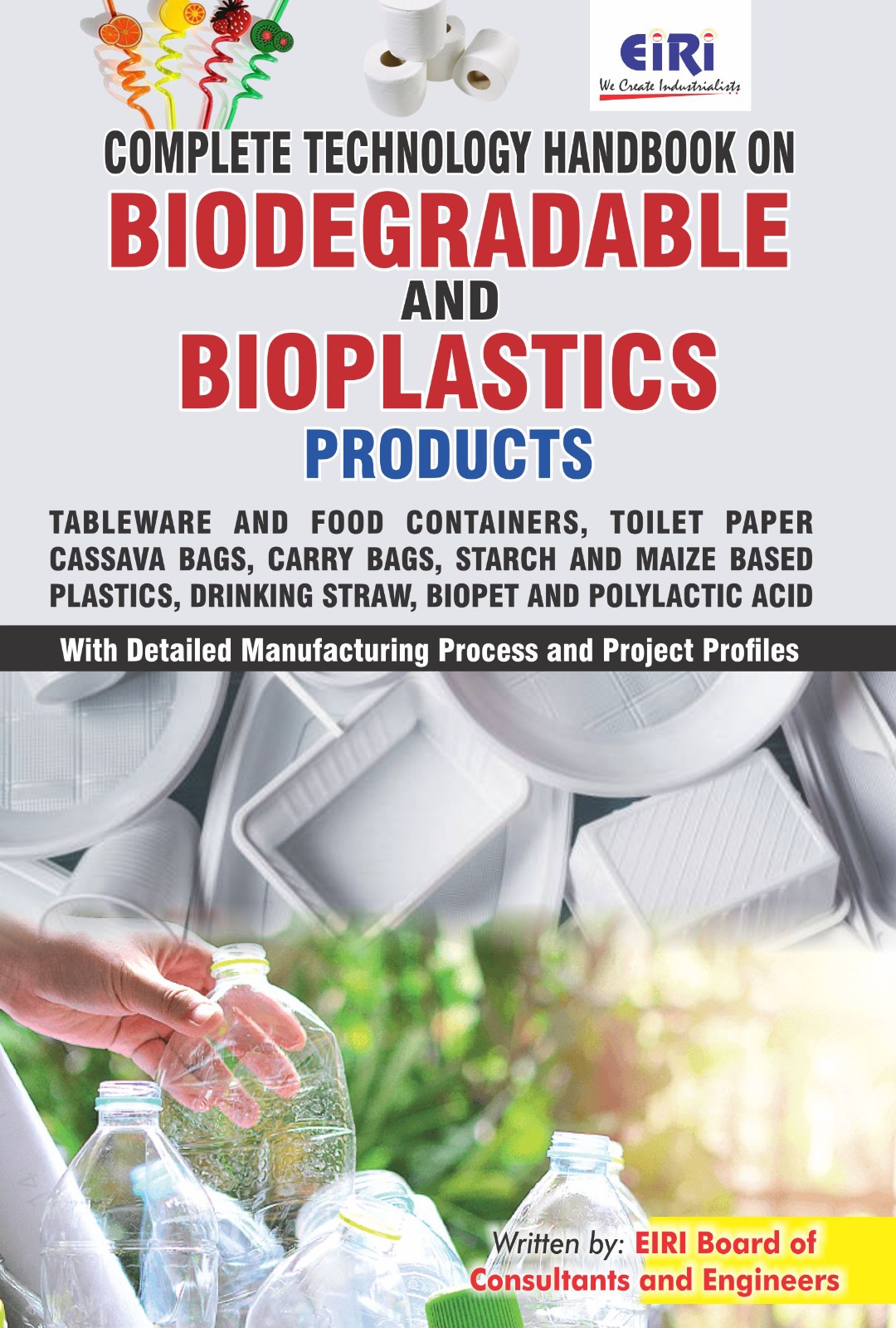
Complete Technology Handbook on Biodegradable and Bioplastics Products like Tableware and Food Containers, Toilet Paper, Cassava Bags, Carry Bags, Starch and Maize Based Plastics, Drinking Straw, Biopet and Polylactic Acid with Detailed Manufacturing Process and Project Profiles
ISBN: 9788189765736
Bioplastics are plastics made from renewable sources like corn starch, vegetable fats and oils, and recovered food waste. Biodegradable products are made from natural resources instead of petroleum, making them eco-friendly alternatives to traditional plastics.
Bioplastic is simply plastic that is created from a plant or other biological source rather than petroleum. It can be created by extracting sugar from plants like corn and sugarcane and converting it into polylactic acids (PLAs), or it can be made from microorganism-engineered polyhydroxyalkanoates (PHAs). Bioplastics are plastics made from renewable biomass sources such vegetable fats and oils, corn starch, straw, woodchips, sawdust, and recovered food waste, among others. Common plastics, such as fossil-fuel plastics (also known as petro-based polymers), on the other hand, are made from petroleum or natural gas.
Biodegradable Products Manufacturing (Bio-Products) are all types of natural and artificial products that can be easily decomposed without causing any damage to the environment. The significant examples of Biodegradable Products are Biodegradable Plastic, Biodegradable Airline Meals, Bio-degradable Toilet Paper, Biodegradable Cups etc. It has become the need of the hour to use these products as most of the goods like Plastics take many years to decompose in nature and this affects the environment adversely with time.
This manual serves as an extensive manual for individuals interested in producing bioplastics and biodegradable items (e.g., compostable bags, plates, cups, etc.). Although the concept of bioplastics has become more popular in recent times, it was not until 1993 that the United Nations Conference on Environment and Development emphasized the necessity for sustainable alternatives to non-renewable materials like plastics.
The book contains chapters on - Biodegradable Plastics Technology, Biodegradable Plastics - Developments and Enviromental Aspects, Bioplastic Carry Bags Manufacturing Technology, BIO-PET Technology, Bio-Plastic Drinking Straws Technology, Food Packaging Applications, Starch-based, Natural Biopolymers and Foam for Food Packaging Technology, Corn and Rice Starch-based Bio-Plastics Biodegradable Plastics Technology, Bioplastics Processing of Dry Ingredients Technology, Bioplastics Recycling Technology, Cassava Bags Manufacturing Technology, Biodegradable Synthetic Polymers Technology, Biodegradable Plastics from Renewable Sources Technology, Biodegradable Plastics from Wheat Starch and Polylactic Acid (PLA), Starch-based Biodegradable Plastics Manufacturing Technology. Polyhydroxyalkanoates (PHAS) Technology, Polylactic Acid (PLA) Technology, Biodegradable Tableware Manufacturing, Biodegradable Plates Manufacturing, Biodegradable Toilet Paper Manufacturing, Biodegradable Polyolefins Technology, Starch for Packaging Technology, Photographs of Plant and Machinery, Plant Economics of 100% Biodegradable Bioplastic, Plant Economics of Bagasse Tableware [Plates, Glass, Bowl, Food Container Etc.], Plant Economics of Biodegradable Carry Bags and Garbage Bags, Plant Economics of Biodegradable Disposable Tableware (By Using Palm Tree Products), Plant Economics of Bioplastic Production from Natural Carbohydrates e.g. Cassava, Corn, Sago, Banana etc., Plant Economics of Fully Automatic Paper Straw (Eco Friendly) Manufacturing Plant, Plant Economics of Oxo Biodegradable Carry Bags, Plant Economics of Wheat Straw, Corn, Cassava Starch or Bagasse Tableware Manufacturing.
Chapter 1
Biodegradable Plastics Technology
Introduction
Properties of biodegradable plastics
Main applications from biodegradable plastics
Bottles
Food containers and trays
The types of biodegradable plastics are:
Biodegradable Vs. Compostable
Definition of Biodegradable
Definition of Compostable
Biodegradable and Compostable Plastics
Pros of Biodegradable and Compostable Plastics
Cons of Biodegradable and Compostable Plastics
Choosing Biodegradable vs. Compostable Products
Bio-Based Plastics
Applications
Bioplastic Packaging
Bioplastics for Consumer Electronics
Food Service
Medical
Aerospace and Automotive
Cosmetics
Types of bioplastic
What are the raw materials for bioplastics?
What are the advantages of bioplastics?
They use diverse feedstocks
They have lots of uses
Renewable Resources
Biopolymers
Introduction
Protein-Based Natural Polymers
Proteins-Based Natural Polymers from an Animal Resource
Protein-Based Natural Polymers from Plant Resources
Polysaccharide-Based Natural Polymers
Polysaccharide-Based Natural Polymers from an Animal Resource
Polysaccharide-Based Natural Polymers from Plant Resource
Lipid-Based Natural Polymers
Proteins
Bags for fruit and vegetables
Garbage bags
Coffee capsules
Packaging
Disposable tableware
Biogenic Materials
The Challenges of Biogenic Materials
Plant Oils
Monomers
Natural Monomers
Amino acids
Nucleotides
Glucose and Related Sugars
Isoprene
Chapter 2
Biodegradable Plastics - Developments and Environmental Aspects
Biodegradable
The ASTM Definition of ‘Biodegradable’
ASTM & ISO Definitions on Environmentally Degradable Plastics
Anaerobic conditions
Aerobic conditions
European Union standards
Aerobic conditions
Future European standards
British standards
Compostable
Treehugger
‘Compostable’ is Defined by the ASTM
Hydro-biodegradable plastics
Photo-biodegradable plastics
Bio-erodable
Biodegradable Starch-based Polymers
Starch blending
Starch/PVA
Starch/PLA
Starch/PCL
Starch/PHB-HV
Starch/PB Sandstarch/PBSA
Ternary Blends
Thermoplastic Starch
Starch Synthetic Aliphatic Polyester Blends
Starch PBS/PBSA Polyester Blends
Starch PVOH Blends
Cellulose-Based Polymers
Cellulose Esters
Biodegradable Polyester Family
PHA (Naturally Produced) Polyesters
Developments
Applications
Degradation Mechanisms and Properties
PHBH (Naturally Produced) Polyesters
Developments
Applications
Degradation Mechanisms and Properties
PLA (Renewable Resource) Polyesters
Developments
Applications
Degradation Mechanisms and Properties
PCL (Synthetic Aliphatic) Polyesters
PBS (Synthetic Aliphatic) Polyesters
Developments
Applications
Degradation Mechanisms and Properties
Modified PET
Degradation Mechanisms and Properties
Developments
Applications
Other Degradable Polymers
Water Soluble Polymers
Vinyl Acetate-Ethylene Copolymer (VAE)
Polyvinyl Alcohol (PVOH)
Uses
Distinctive and Unique Properties
Processing of PVOH
Recyclability of PVOH
The Future Role of PVOH
Ethylene Vinyl Acetate Emulsions (EVA)
Features
Application
Carboxymethyl Cellulose (CMC)
Polyanionic Cellulose (PAC)
Controlled Degradation Additive Masterbatches
Definition
Components
Polymer Carrier
Additives
Benefits of using additive masterbatch
Precision and consistency
Cost efficiency
Customization
Improved processing
Enhanced product performance
Different types of additive masterbatch
Lubricating additive masterbatch
Flexible plasticized additive masterbatch
Stability-enhancing additive masterbatch
Longevity-boosting plastic anti-aging additives
Dust-repelling anti-static additive masterbatch
Fire retardant additives for plastic safety
Porosity-increasing additives for finished products
Deodorizing additives for consumer comfort
Emerging Application Areas of biodegradable plastics
Coated Paper
Agricultural Mulch Film
Shopping Bags
Food Waste Film and Bags
Consumer Packaging Materials
Landfill Cover Film
Other Applications
Standards and test methods
Biodegradation Standards and Tests
American Society for Testing and Materials
ASTM D5338-93 (Composting)
ASTM D5209-91 (Aerobic, Sewer Sludge)
ASTM D5210-92 (Anaerobic, Sewage Sludge)
ASTM D5511-94 (High-solids Anaerobic Digestion)
ASTM Tests for Specific Disposal Environments
International Standards Research
International Standards Organisation
European Committee for Normalisation
‘OK Compost’ Certification and Logo
Compost Toxicity Tests
Plant Phytotoxicity Testing
Animal Toxicity Test
Difference Between Standards for Biodegradation
Development of Australian Standards
Disposal Environments
Composting Facilities and Soil Burial
Key Factors Defining Compostability
Physical Persistence
Chemical Persistence
Toxicity
Effect on Quality of Compost
Anaerobic Digestion
Waste Water Treatment Plants
Reprocessing Facilities
Landfills
Marine and Freshwater Environments
Litter
Plastics Sorting and Reprocessing
Key Issues
Recyclable Plastics Sorting Considerations
Reprocessing Considerations
Polyolefin Reprocessing
Polyethylene Reprocessing
Potential Positive Environmental Impacts
Composting
Landfill Degradation
Energy Use
Greenhouse Gas Emissions
Potential Negative Environmental Impacts
Pollution of Aquatic Environments
Increased Aquatic BOD
Water Transportable Degradation Products
Risk to Marine Species
Litter
Compost Toxicity
Recalcitrant Residues
Aromatic Compounds
Additives and Modifiers
Isocyanate Coupling Agents
Plasticisers
Fillers
Catalyst Residues
Prodegradants and Other Additives
Source of Raw Materials
Development of Australian Standards and Testing
Life-Cycle Assessment
Minimisation of Impact on Reprocessing
Determination of Appropriate Disposal Environments
Education
Chapter 3
Bioplastic Carry Bags Manufacturing Technology
Product Description
Product Uses
Raw Material Requirement
Benefits of Starting a Biodegradable Plastic Bag Business
Types of Biodegradable Plastic Bag
Advantages of Using Biodegradable Bags
Manufacturing Process
Indian Standards For The Product
Biodegradable Plastic Bags Raw Material
Plant & Machinery
License & Approvals
Bioplastics
Environmental Impact of Plastic Waste
Types of Plastics Commonly Used and Their Properties
Plastic Recycling Overview
Benefits of Recycling Plastic
Different Types of Plastic Recycling Processes
Mechanical recycling
Chemical recycling
Feedstock recycling
Pyrolysis
Biodegradation
Challenges of Plastic Recycling
The plastic recycling process steps
Collection + distribution
Sorting + categorizing
Washing
Shredding
Identification and separation of plastics
Extruding + compounding
types of plastic
Number 1: PETE (or PET) – Polyethylene Terephthalate
Number 2: HDPE – High-Density Polyethylene
Number 3: PVC – Polyvinyl Chloride
Number 4: LDPE – Low-Density Polyethylene
Number 5: PP – Polypropylene
Number 6: PS – Polystyrene
Number 7: Other
Chapter 4
BIO-PET Technology
characteristics of Bio-PET
BioPET as a replacement for Virgin PET
New developments in PET packaging
Biodegradable plastics
Bio-Based Polymers
Biodegradable Packaging Options: Biopolymers and Bioplastics
features of Bio-based polyester
Carbon sequestration
Reduced greenhouse gas emissions
More sustainable
Range of applications
Promising barrier and mechanical properties
The Benefits of Biopolymer Bottles
Biopolymer Bottle Types
Bottle-to-bottle Recycling
Development of the “Bottle to Bottle” Horizontal Recycling System
Adoption of F-to-P direct recycling technology
“Bottle to Bottle” Horizontal Recycling Progress Through Packaging Improvements
Washing Line
Pelletizing
Continuous SSP
Chapter 5
Bio-Plastic Drinking Straws Technology
Benefits of Switching to Biodegradable Straws
Types of biodegradable straws
Paper straws
PHA straw
PLA straw
Reed straws
Wheat straws
Cornstarch straws
Bamboo straw
Sugarcane Bagasse Straws
Environmental Benefits of Sugarcane Straws
Advantages of Sugarcane Straws over Paper
Straws
Not Soggy
Heat Resistant
Food Safe
Technology Process
Pulp cooking process
Pulp washing process
Pulp bleaching process
Chemi-mechanical pulping process
Making Eco-Friendly Rice Straws
Rice straw production process
Produce rice starch
Weigh and mix rice starch
Steam
Shape
Dry
Check the quality and pack
Biodegradable rice drinking straw processing line manufacturing process
Biodegradable Sugarcane Straws for Drinks
Technical Parameters
Operations:
Chapter 6
Food Packaging Applications
Bio-based Plastics in Food Packaging
Advantages of Bio-based Food Packaging
Polymers Produced from Biomass
Starch
Polylactic acid (PLA)
Chitosan
Microalgae polysaccharides
Alginate
Lignin
Pectin
Carrageenan
Polymers from Bio-derived Monomers
Polymer Packaging Materials
Petroleum based plastic materials
Biobased Packaging Material
Microbially Originated Polymers
Polymers Produced from Micro-Organisms
Polysaccharides
Other biopolymers
Mass production and customization
Properties of Packaging Materials
Gas Barrier Properties
Glass
Metals
Plastic
Laminates
Additives and enhanced packaging
Types of Barrier Properties
Gas Barrier
Moisture Barrier
Light Barrier
Microbial Barrier
Mechanical Recycling of Bioplastics
Biodegradability
Packaging Products from Bio based Materials
Biodegradable packaging: developments and challenges
Chapter 7
Starch-based, Natural Biopolymers and Foam for Food Packaging Technology
Starch-based Packaging Materials
Cellulose-based Packaging Materials
Chitosan and Pectin-based Packaging Materials
Polyhydroxyalkanoate-based Packaging Materials
Polylactic Acid-based Packaging Materials
Bionanocomposites in Food Packaging
Properties of Polylactic Acid Bionanocomposites
Biodegradable Polymeric Foams
Development of Polymeric Foams
Sustainable Food Packaging using Bio-based Polymeric Foams
Processing Technology for Foam Fabrication
Physical/Soluble Foaming
Casting and Leaching
Foaming using Gases
Thermally Induced Phase Separation (TIPS)
Reactive Foaming
Foam Packaging
Developments in Sustainable Foams
Chapter 8
Corn and Rice Starch-based Bio-Plastics Biodegradable Plastics Technology
Introduction
Extraction of Starch
Preparation of Bioplastics Film
Characterization
Tensile Test
Thickness Measurement
Test for Moisture Content
Water Solubility Test
Water Contact Angle Measurement
Biodegradability Test
Scanning Electron Microscopy (SEM)
Thermogravimetric Analysis
Sealing Properties of Bioplastics
Tensile Properties
Bioplastic Thickness
Moisture Content
Water Solubility
Water Contact Angle
Biodegradability Properties
Thermogravimetry Analysis
Sealing Properties of Bioplastics
Starch: The Future of Sustainable Packaging
Starch blends with compostable polymers:
Antimicrobial packaging film
Starch based nanocomposite films
Heat sealing packaging
Starch grafted emulsions for packaging:
Chapter 9
Bioplastics Processing of Dry Ingredients Technology
Introduction
Ingredient Properties Affecting Feedrates and Dry Ingredients Handling
Name
Bulk Density
Particle Form
Particle Size
Angle of Repose
Angle of Slide
Packing and Compaction
Packing, By Pressure
Compacting, By Vibration
Moisture Content
Storage Hoppers and Ingredient Activation
Vibration
Internal Stirring Agitation
Concentric Screw Agitation
External Agitation (Flexible Hopper)
Volumetric Feeders
Single Screw Feeders - Sizing and Feed Rate Calculation
Screw Sizing
Screw Fill Efficiency
Feed Rate Calculation
Feeder Selection
Spiral Screw
Blade Screw
Twin Screw Feeders
Twin Concave Screws
Vibrating Tray Feeders
Belt Feeders
Loss-In-Weight Feeders
Scale
Feed Device
Weigh Hopper
Feeder Controller
Refill Device
Principle of Operation-Continuous Feeding from a Loss-In Weight Feeder
Loss-In-Weight Feeding Helpful Comments
Refilling a Loss-In-Weight Feeder
Venting a Loss-In-Weigh Feeder
In Plant Vibration Effects on Feeder Performance
Temperature Effects in Feeder Performance
Scale Stabilization Time
Flexible Connections
Special Feeders for BioPlastics Ingredients
Bio Ingredients-Typical Physical Characteristics
The Physical Characteristics Aggravate Controlled Rate Feeding
Fibers Need to be Tested in Feeders to Determine How They Can Be Fed
Start with a Traditional Feeding Device, Example a Screw Feeder
Feeder Control and Checking the Feed Rate
Ingredient Storage and Keeping the Feeder Full
Chapter 10
Bioplastics Recycling Technology
Introduction
Recycling Routes
Recycling material
Mechanical Recycling
Chemical Recycling
Chemical Recycling strategies
Biodegradation/composting
Biological recycling
Incineration
Anaerobic digestion
Energy recovery
Landfill
Leakage into the environment
Comparative overview of end-of-life options
Chapter 11
Cassava Bags Manufacturing Technology
Opportunities
Manufacturing Process of Eco-Friendly Cassava Bags
Production of Granules
Film Production
Production of Bags
Types of Cassava Bags
Cassava Grip-Hole Bags
Cassava T-shirt Bags
Cassava Garbage Bags
Pros and Cons of Cassava Bags
The Benefits of Cassava Bags
Biodegradable Cassava Eco-Friendly Bags
Edible
Biodegradable
Compostable
Versatile
The Disadvantages of Cassava Bags
Produce Methane
Extensive Manufacturing
Plastics from Potato Waste
Potato starch bioplastic applications
Potato starch bioplastic pros and cons
Pros
Biodegradability
Renewable resource
Lower carbon footprint
Versatility
Biocompatibility
Consumer appeal
Cons
Cost
Limited durability
Production challenges
Competing uses for raw materials
Limited recycling options
Biodegradation time
How to make bioplastic from potato starch?
Step 1: Prepare the materials
Step 2: Extract the Starch
Step 3: Mix the potato starch and water
Step 4: Heat the mixture
Step 5: Add glycerol and vinegar
Step 6: Pour the mixture into a mold
Step 7: Remove the bioplastic from the mold
Chapter 12
Biodegradable Synthetic Polymers Technology
Introduction
Objective of the present invention
Preferred Embodiments
Claims
Chapter 13
Biodegradable Plastics from Renewable Sources Technology
Raw Material of Bioplastics
Bioplastic Classification
Non-biodegradable bioplastics
Partially biodegradable or durable bioplastics
Compostable plastics
Chemical Ingredients of Bioplastics
Polylactic Acids (PLA)
Polyhydoxyalkaneoates (PHA)
Uses and Application of Bioplastics
Bioplastic Manufacturing
Additives and Modifiers for Biopolymers
Toughness
Processability
Heat Resistance
Foamability
Mechanical Properties
Processing Biodegradable Polymers
Introduction
Injection Molding
NatureWorksIngeo Series
Compression Molding
Film Casting
Chapter 14
Biodegradable Plastics from Wheat Starch and Polylactic Acid (PLA)
Introduction
Starch based Bio-plastic
Advantages of plastic bags made from wheat starch
Disadvantages and challenges of wheat starch-based plastic bags
Minh Sang Packaging Provides high-quality wheat starch plastic bags
Wheat Janeng starch
Wheat starch and polypropylene
Wheat straw
Wheat gluten
Wheat Biocomposite
Wheat Biocomposite Advantages and Applications
Wheat Biocomposite Fabrication
Biodegradable Polylactic Acid and Its Composites
PLA Structure
Properties of PLA
PLA Production
Direct Polycondensation
Ring-Opening Polymerization (ROP)
Modified PLA
Copolymers
Blending with Nano composites
Blending with Other Polymers
PLA Degradation
PLA Composite Materials
Natural Fibers
Cellulose Nanocrystals
Lignin
Silk Fiber
PHA
PBAT
Methods for Manufacturing PLA-Based Composites
Microcellular Injection Molding
Extrusion Molding
Compression Molding
PLA Composites for Sports Applications
Sportswear
Helmets
Protective Sports Gear
Surfboards
Sports Medicine Tools
3D Printed Sports Equipment
Limitations of PLA Composites in Sports Applications
Chapter 15
Starch-based Biodegradable Plastics Manufacturing Technology
Introduction
Reason for transition from synthetic plastic materials to biobased plastic materials
Biodegradability and Compostability
Bioplastic as Packaging Material
Polylactic acid (PLA)
Cellophane
Cellulose acetate
Starch
Starch Polymer
Starch-filled Plastics
Thermoplastic Starch
Why Use Starch as Packaging Material?
Starch: The Future of Sustainable Packaging
Starch blends with compostable polymers
Antimicrobial packaging film
Starch based nanocomposite films
Heat sealing packaging
Starch grafted emulsions for packaging
Processing of sample (Bioplastic Preparation)
Bioplastic from Potato starch
Bioplastic from Cassava starch
Bioplastic from Corn starch
Bioplastic from Banana peel
Bioplastic from Mangoseed
Degradation by burring in soil
Degradation by amylase enzyme
Ash test
Water uptake activity
Chapter 16
Polyhydroxyalkanoates (PHAS) Technology
Introduction
General Characteristics of PHAs
Benefits of Bioplastics and PHAs in Particular
Extraction methods
Solvent recovery
Green solvent recovery
Enzymatic recovery
Animal recovery methods
Isolation and screening
Reagents Preparation
Trace Elements Solutions
HCl (=35%) Solution Preparation
Media Preparation
PHA Detecting Agar
Nutrient Broth and Nutrient Agar
Fermentation Medium
Seed Culture Preparation
Sample Collection
Waste Collection
Submerged Fermentation for PHA Production
Extraction of PHA Produced during Fermentation
Quantification of Produced PHA
Characterization of the Extracted PHA by FTIR
Molecular Identification of the Most Efficient PHA Producing Strain
Optimization of Cultural Conditions
PHA Film Preparation
Statistical Analysis
Chapter 17
Polylactic Acid (PLA) Technology
Introduction
Manufacturing of PLA products
Benefits of PLA products
The environmental benefits
The food packaging benefits
(Biodegradable) Starch based plastics
Starch based films
Biodegradable (and bio-based) films
Flexible films based on biodegradable polyesters
Trays and other thermoformed products (Bio-Based)
Other packaging products (Bio-Based)
PLA packaging products
Optical Properties
Chapter 18
Biodegradable Tableware Manufacturing
Manufacturing Bio-Degradable Cutlery From Sugarcane Bagasse
Manufacturing Process of Bio-Degradable cutlery from Sugarcane Bagasseis
Sugarcane bagasse waste for food packaging
How is biodegradable bagasse Cutlery made?
Advantages of Bio-Degradable Cutlery from Sugarcane Bagasse
Applications of Bio-Degradable cutlery from Sugarcane Bagasse
Machines Used to Manufacture Bagasse Tableware
Automatic Tableware Forming Machine
Tableware Edge Trimming Machine
Production Molds
Cornstarch Tableware
Advantages of disposable degradable tableware:
Bamboo Tableware
Manufacturing process of bamboo tableware
Types of kitchenware that can be made using bamboo
Cutting board
Bamboo tea infuser
Bamboo rolling pin
Bamboo chopsticks
Bamboo cutlery
Benefits of using bamboo based tableware
Environmentally friendly
Durable and versatile
Say goodbye to scratches on pots and pans
Palm Leaf Tableware
Introduction
The Natural Elegance
Unveiling the Aesthetics of Palm Leaf Plates
Unique Texture and Visual Appeal
Sustainable Beauty
Crafting Process
Harvesting and Selecting Palm Leaves
Handcrafting Techniques
Eco-Friendly Production
Versatility in Use
Ideal for Various Occasions
Serving Culinary Delights
Perfect for Events and Parties
Biodegradability
Breaking Down the Environmental Impact
Comparison with Other Disposable Plates
Cultural Significance
Historical Roots
Symbolism in Different Cultures
Modern Adoption and Popularity
Sustainable Living
Contributing to a Greener Planet
Supporting Local Communities
Palm Leaf Plates in the Circular Economy
Maintaining Quality
Storage and Shelf Life
Resistance to Heat and Moisture
Manufacturing: Turning Leaves into Plates
Plate Making Machine
Chapter 19
Biodegradable Plates Manufacturing
Characteristics of Bagasse
Renewable
Compostable
Easily Available
Benefits of using biodegradable plates
Easy composting
Safe to use with microwave
Highly energy efficient
Nontoxic
Saves Non-renewable Sources of Energy
Reduces Carbon Emission
Provides an Eco-Friendly Solution
Manufacturing Process of Areca Leaf Plates
Collecting Raw Material
Drying the Areca Sheath
Cleaning the Areca Sheath
The Areca Leaf Plate Making Machine
Pressing the Plates
Waste Sheaths
Grading the Areca Leaf Plates
Chapter 20
Biodegradable Toilet Paper Manufacturing
Types of Biodegradable Toilet Paper
The Toilet Paper Manufacturing Process
Making toilet paper from the trees
Steps:
Chapter 21
Biodegradable Polyolefins Technology
Introduction
General procedure for grafting of sugars onto poly(styrene maleic anhydride)
Determination of biodegradability of polymers using aerobic microorganisms
Supplementary Data
Weight loss data
FTIR Spectral Data:
Quantification of carbohydrate groups linked to poly(styrene-maleic anhydride) by silylation of the carbohydrate hydroxyl’s and NMR anlysis of the spectrum
Molecular weight decrease after biodegradation by GPC
Chapter 22
Starch for Packaging Technology
Bioplastic as Packaging Material
Cellophane
Cellulose acetate
Starch
Food packaging characteristics
Bioplastic packaging
Recent Advances in Starch Based Composites for Packaging Applications
Antimicrobial packaging film:
Plasticized Starch and Fiber Reinforced Composites for Packaging Applications
Protein-Starch Based Plastic Produced by Extrusion and Injection Molding
Temperature
Moisture
Genetically modified bioplastics
Chapter 23
Photographs of Plant and Machinery
Biodegradable Bag Making Machine
Corn Starch Biodegradable Bag Machine
Biodegradable or Compostable machine
Biodegradable Carry Bag Cutting and Sealing Machine
Biodegradable Carry Bag Machine
Description
Biodegradable Plastic Film Machine
Blown Film Machine
Areca Leaf Plate Machine
Betel Leaf Plate Machine
Areca Food Container Machine
Bagasse Tableware Pulp Molding Machine
Egg Tray Machine
Straw Making Machine
Chapter 24
Plant Economics of 100% Biodegradable Bioplastic
Land & Building
Plant & Machinery
Fixed Capital
Working Capital Requirement/Month
Total Capital Investment
Turn Over/Annum
Chapter 25
Plant Economics of Bagasse Tableware (Plates, Glass, Bowl, Food Container etc.)
Land & Building
Plant & Machinery
Fixed Capital
Working Capital Requirement/Month
Total Capital Investment
Turn Over/Annum
Chapter 26
Plant Economics of Biodegradable Carry Bags and Garbage Bags
Land & Building
Plant & Machinery
Fixed Capital
Working Capital Requirement/Month
Total Capital Investment
Turn Over/Annum
Chapter 27
Plant Economics of Biodegradable Disposable Tableware (By Using Palm Tree Products)
Land & Building
Plant & Machinery
Fixed Capital
Working Capital Requirement/Month
Total Capital Investment
Turn Over/Annum
Chapter 28
Plant Economics of Bioplastic Production from Natural Carbohydrates e.g. Cassava, Corn, Sago, Banana etc.
Land & Building
Plant & Machinery
Fixed Capital
Working Capital Requirement/Month
Total Capital Investment
Turn Over/Annum
Chapter 29
Plant Economics of Fully Automatic Paper Straw (Eco Friendly) Manufacturing Plant
Land & Building
Plant & Machinery
Fixed Capital
Working Capital Requirement/Month
Total Capital Investment
Turn Over/Annum
Chapter 30
Plant Economics of Oxo Biodegradable Carry Bags
Land & Building
Plant & Machinery
Fixed Capital
Working Capital Requirement/Month
Total Capital Investment
Turn Over/Annum
Chapter 31
Plant Economics of Wheat Straw, Corn, Cassava Starch or Bagasse Tableware Manufacturing
Land & Building
Plant & Machinery
Fixed Capital
Working Capital Requirement/Month
Total Capital Investment
Turn Over/Annum
