The global textile sector is rapidly shifting toward sustainable and eco-friendly materials, and hemp fiber is becoming one of the most promising alternatives to conventional textile fibers such as cotton and synthetic materials. Hemp fabric is valued for its durability, breathability, antibacterial nature, and low environmental impact. Unlike many traditional textile crops, hemp requires less water, fewer pesticides, and grows quickly, making it an attractive raw material for environmentally responsible textile production.
For entrepreneurs looking to establish a manufacturing business rather than a trading venture, hemp textile production provides multiple opportunities along the value chain. A hemp textile manufacturing unit can focus on yarn production, fabric manufacturing through weaving or knitting, dyeing and printing operations, or even the production of finished textile goods. Some businesses also choose to integrate all stages into a complete textile production facility.
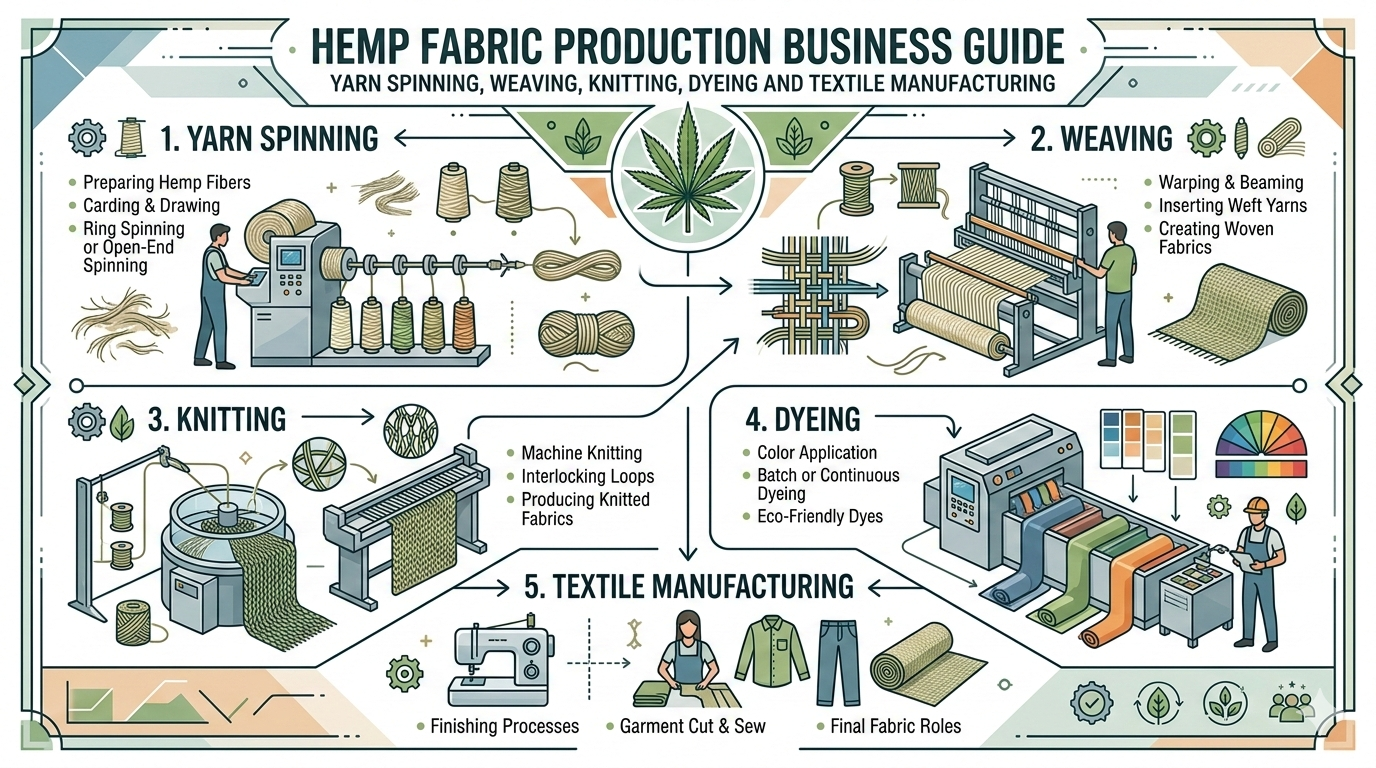
Starting a hemp fabric production unit requires a clear understanding of the manufacturing processes, machinery requirements, and production flow. The following sections explain the major stages of hemp textile manufacturing, from fiber processing to finished textile products, with a focus on practical insights useful for entrepreneurs planning to establish a production facility.
Introduction to Hemp Fiber for Textile Manufacturing
Hemp fiber is obtained from the bast fibers found in the outer layer of the hemp plant stem. These fibers are long, strong, and naturally resistant to wear and environmental stress. Because of these characteristics, hemp textiles are known for their strength and longevity. Historically, hemp has been used to produce ropes, sails, and durable fabrics, but modern processing technologies have made it suitable for soft apparel textiles as well.
In recent years, hemp textiles have gained attention due to increasing environmental awareness and consumer demand for sustainable fabrics. Textile manufacturers are exploring hemp as a substitute for cotton in many applications, especially in eco-friendly clothing and home textiles.
Key characteristics that make hemp fiber suitable for textile manufacturing include:
- Hemp fibers are extremely strong, often stronger than cotton fibers, resulting in durable fabrics.
- The fiber structure allows good air circulation, making hemp fabrics breathable and comfortable.
- Hemp naturally resists bacteria and mold, which helps maintain fabric hygiene.
- The crop requires relatively low agricultural inputs compared to many other fiber crops.
- Hemp fibers absorb moisture efficiently, which improves comfort in clothing applications.
- The material is biodegradable, supporting sustainable textile production.
- Hemp fabrics become softer with repeated washing without losing strength.
These advantages make hemp a valuable raw material for a wide range of textile products including garments, upholstery, home textiles, and industrial fabrics.
Raw Material Preparation and Fiber Processing
Before hemp can be converted into yarn, the plant fibers must be separated and cleaned through several mechanical and biological processes. Proper fiber preparation is essential because the quality of the fiber directly affects yarn strength and fabric quality. Entrepreneurs planning a vertically integrated manufacturing facility should understand these early stages of fiber processing.
After harvesting hemp plants, the stems contain both useful fibers and woody material that must be separated. Fiber extraction and cleaning ensure that the bast fibers are ready for spinning operations.
Important steps in hemp fiber preparation include:
- Retting Process: The harvested hemp stems undergo retting, a biological process that breaks down the natural substances binding fibers to the woody core. This process helps separate the fiber bundles from the stem structure.
- Decortication: Mechanical decorticators break the hemp stalks and separate the outer bast fibers from the inner woody core known as hurd.
- Scutching: This process removes residual woody particles and impurities that remain attached to the fibers after decortication.
- Fiber Cleaning: Dust, plant residues, and unwanted materials are removed using mechanical cleaning equipment.
- Hackling or Combing: Fibers are combed to align them and separate long fibers from short ones, improving spinning quality.
- Fiber Grading: Fibers are classified according to length, strength, and fineness to determine their suitability for various textile applications.
- Fiber Conditioning: Moisture content is adjusted to make the fibers more flexible for the spinning process.
Once these processes are completed, the fibers are ready to enter the textile manufacturing stage where they are converted into yarn.
Hemp Yarn Manufacturing (Spinning Process)
Yarn production is one of the most critical stages in hemp textile manufacturing because yarn quality determines the performance of the final fabric. The spinning process transforms loose fibers into continuous yarn strands by aligning and twisting the fibers together. Modern spinning technology allows hemp fibers to be processed into yarns suitable for apparel fabrics as well as industrial textiles.
The spinning process involves multiple steps designed to clean, align, and gradually reduce the thickness of fiber strands until they become yarn.
The major stages of hemp yarn production include:
- Fiber Opening: Compressed fiber bundles are opened and loosened to prepare them for further processing. This stage ensures that fibers are separated evenly before entering the carding process.
- Carding: Carding machines straighten and align fibers while removing impurities and very short fibers. The output of this stage is a soft rope-like strand called sliver.
- Combing: For high-quality yarns, combing is used to remove shorter fibers and improve alignment, producing smoother and finer yarn.
- Drawing: Multiple slivers are combined and stretched in drawing frames to improve uniformity and fiber alignment. This stage reduces irregularities in the fiber strand.
- Roving Formation: The drawn sliver is slightly twisted to create roving, which is a thinner strand prepared for spinning.
- Spinning: The roving is twisted further in spinning machines to produce yarn with the desired thickness and strength.
- Winding: The finished yarn is wound onto bobbins or cones for use in weaving or knitting processes.
Depending on the intended fabric application, manufacturers may use either wet spinning or dry spinning techniques, which influence the softness and fineness of the yarn.
Fabric Manufacturing: Weaving and Knitting
After yarn production, the next stage in hemp textile manufacturing is converting yarn into fabric. This can be done through either weaving or knitting technologies. Each method produces fabrics with different structural properties and applications.
Entrepreneurs starting a hemp textile unit may choose either weaving or knitting depending on the type of products they want to manufacture.
Key aspects of fabric manufacturing include:
- Weaving Method: In weaving, two sets of yarns are interlaced at right angles to form fabric. Warp yarns run lengthwise, while weft yarns run across the width. This method produces strong and stable fabrics.
- Knitting Method: Knitting forms fabric by creating interlocking loops of yarn. Knitted fabrics are generally more flexible and stretchable than woven fabrics.
- Warp Preparation: Before weaving, warp yarns must be arranged parallel to each other and wound onto beams through a process called warping.
- Sizing Process: Warp yarns are coated with a protective sizing material to increase strength and reduce breakage during weaving.
- Loom Operation: Weaving looms interlace warp and weft yarns according to the desired fabric structure. Modern looms operate at high speeds for efficient production.
- Circular and Flat Knitting Machines: Knitting units use specialized machines to create tubular or flat fabrics depending on product requirements.
- Fabric Inspection: After weaving or knitting, the fabric is inspected for defects before moving to dyeing or finishing operations.
The choice between woven and knitted hemp fabrics depends on whether the final products require strength, flexibility, or elasticity.
Dyeing and Printing of Hemp Fabrics
Hemp fabric in its natural form typically has a light beige or grey color. To produce commercially attractive textiles, manufacturers often apply dyeing and printing processes. These processes add color and patterns to the fabric while improving its aesthetic appeal.
Before dyeing, fabrics must undergo preparation treatments to remove impurities and enhance dye absorption.
Key aspects of hemp fabric dyeing and printing include:
- Fabric Preparation: The fabric undergoes processes such as desizing, scouring, and bleaching to remove oils, waxes, and impurities.
- Dye Absorption: Hemp fibers absorb dyes effectively due to their porous structure, allowing vibrant and long-lasting colors.
- Reactive Dyeing: Reactive dyes are commonly used because they bond chemically with the fiber, producing durable colors.
- Vat Dyeing: This method is used for heavy fabrics and denim-style textiles that require strong color fastness.
- Natural Dyeing: Some manufacturers use plant-based dyes to maintain environmentally friendly production standards.
- Fabric Printing: Patterns and designs can be added using screen printing, rotary printing, or digital textile printing technologies.
- Color Fixing and Washing: After dyeing or printing, the fabric is washed and treated to fix the colors and remove excess chemicals.
Proper dyeing and printing techniques are essential for producing high-quality hemp textiles that meet commercial fashion and home textile standards.
Fabric Finishing Processes
Finishing processes improve the appearance, texture, and performance of hemp fabrics. Without finishing treatments, hemp textiles may feel rough or stiff. Modern finishing technologies help produce softer fabrics suitable for clothing and home textiles.
Finishing operations add functional and aesthetic qualities to the fabric.
Common finishing processes include:
- Softening Treatment: Chemical or mechanical softening processes improve the hand feel of hemp fabric, making it more comfortable for clothing.
- Calendaring: Fabric passes through heated rollers to produce a smooth and glossy surface.
- Shrinkage Control: Treatments are applied to minimize fabric shrinkage during washing.
- Anti-Microbial Finishing: Hemp fabrics can be treated to enhance their natural resistance to bacteria.
- Water-Repellent Finishing: Special coatings can be applied to make fabrics resistant to water and moisture.
- Wrinkle Resistance Treatment: Finishes are used to improve crease resistance and maintain fabric shape.
- Final Fabric Inspection: The finished fabric is checked for quality before being supplied to garment manufacturers or converted into finished products.
Finishing significantly enhances the commercial value of hemp textiles.
Final Product Manufacturing
After finishing, hemp fabrics are used to manufacture a wide range of textile products. Entrepreneurs may choose to integrate garment or product manufacturing with fabric production to increase value addition.
Hemp textiles are suitable for multiple industries including apparel, home furnishings, and industrial textiles.
Common hemp textile products include:
- Apparel Products: Shirts, trousers, jackets, dresses, and casual wear are increasingly made from hemp fabrics due to their durability and comfort.
- Activewear and Sportswear: Hemp blends are used in athletic clothing because of their moisture absorption and breathability.
- Home Textile Products: Curtains, upholstery fabrics, bed sheets, and cushion covers are popular applications.
- Eco-Friendly Bags: Hemp fabric is widely used for tote bags, backpacks, and shopping bags.
- Industrial Textiles: Strong hemp fabrics are used for canvas, tarpaulins, and protective materials.
- Footwear Materials: Hemp textiles are used in shoe uppers and eco-friendly footwear designs.
- Fashion Accessories: Hats, belts, scarves, and other accessories are manufactured using hemp fabric.
Expanding into finished products allows manufacturers to capture higher profit margins.
Business Potential for Hemp Fabric Manufacturing
The demand for hemp textiles is increasing globally as consumers and brands shift toward sustainable materials. For entrepreneurs, hemp fabric production offers strong growth potential in both domestic and export markets.
Important factors that make hemp textile manufacturing attractive include:
- Growing demand for eco-friendly clothing and sustainable fabrics.
- Increasing use of natural fibers in premium fashion brands.
- Government support for sustainable agriculture and textile innovation in many countries.
- Opportunities to integrate multiple stages of textile production for higher value addition.
- Rising demand for biodegradable materials in packaging and industrial textiles.
- Expansion of organic and environmentally responsible fashion markets.
- Potential for export to regions where hemp textiles are already popular.
With proper technology, reliable raw material supply, and effective market positioning, entrepreneurs can successfully establish a profitable hemp textile manufacturing business.
Conclusion
Hemp fabric manufacturing represents a high-potential sustainable textile industry for entrepreneurs interested in establishing a manufacturing business. The production chain includes several stages such as fiber processing, yarn spinning, weaving or knitting, dyeing, finishing, and final product manufacturing.
Although the technology is similar to cotton and linen textile production, hemp fibers require specialized processing techniques to achieve softness and textile-grade quality. With increasing global demand for sustainable materials, hemp textiles offer significant business potential.
Entrepreneurs can start with a specialized unit such as yarn spinning or fabric manufacturing, or develop a fully integrated hemp textile plant covering the entire value chain. With the right technology, quality control, and market strategy, hemp fabric production can become a profitable and future-oriented manufacturing business.